The Logging Problem
Nutrition logging has a retention problem. Research published in the Journal of Medical Internet Research found that fewer than 3% of nutrition app users maintain daily logging beyond six months. The reason isn't motivation — it's friction. Manual logging is tedious, and tedious habits don't stick.
AI-powered logging attempts to solve this by replacing text searches and manual data entry with photo recognition, barcode scanning, and voice input. But does faster logging mean better logging? And are there situations where manual entry still wins?
A 2019 systematic review analyzed 15 dietary assessment studies and found that image-assisted methods reduced time-per-entry by 30–50% while maintaining comparable accuracy for calorie and macronutrient estimates.
"The future of dietary assessment lies in reducing user burden. Technologies that automate the most tedious parts of food logging — identification and portion estimation — will be key to achieving the long-term adherence needed for meaningful health outcomes." — Journal of Medical Internet Research
This guide compares both approaches across the metrics that actually matter: speed, accuracy, learning value, and long-term adherence.
How Manual Logging Works
Manual nutrition logging means searching a food database, selecting the correct item, and entering the portion size by hand. Depending on the app, you might also specify the brand, cooking method, or specific variant (e.g., "chicken thigh, skin removed, grilled").
Strengths of Manual Logging
- Precision control: You choose exactly which database entry to use and specify the exact weight or volume. For people who weigh their food on a kitchen scale, manual entry can be extremely precise.
- Educational value: Typing "oats 80g" every morning builds an intuitive understanding of portion sizes and calorie density that passive methods don't reinforce as strongly.
- Works for any food: There's no dependency on lighting, camera angle, or visual distinctiveness. If you can describe it, you can log it.
Weaknesses of Manual Logging
- Slow: Logging a three-item meal takes 2–4 minutes. Over three meals and two snacks, that's 10–15 minutes per day on data entry alone.
- Database confusion: Searching "rice" returns dozens of entries — white rice, brown rice, basmati, jasmine, instant, cooked, uncooked. Picking the wrong one introduces silent errors.
- Recall bias: If you log hours after eating, you're more likely to forget condiments, beverages, or side dishes.
- Adherence cliff: The time cost compounds. Most manual loggers give up within the first month because the effort stops feeling worth it.
How AI-Powered Logging Works
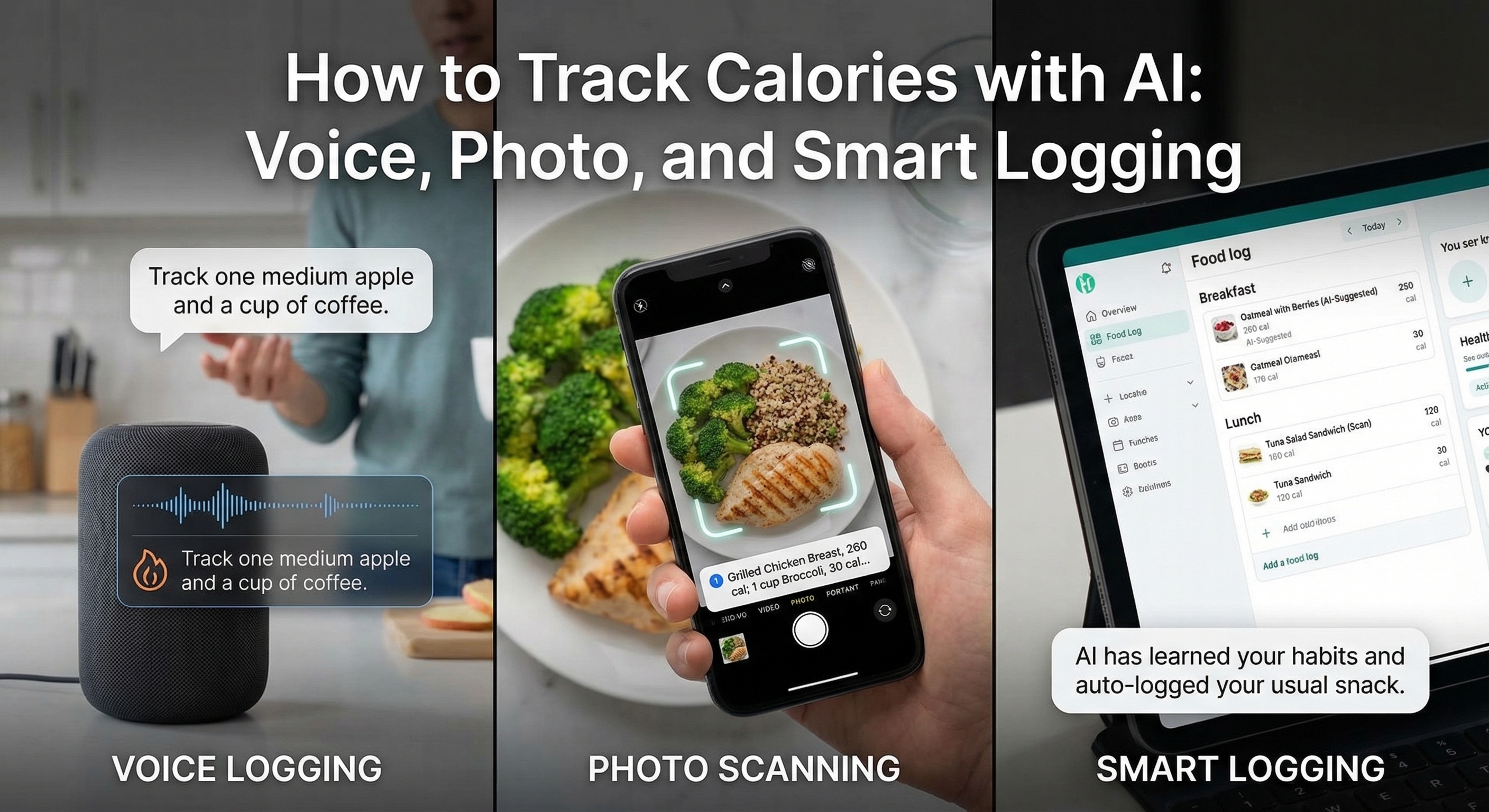
AI logging uses computer vision, barcode recognition, and natural language processing to automate the data entry step. The most common approach is photo recognition: you take a picture of your meal, and the AI identifies foods, estimates portions, and logs the nutritional data automatically.
Strengths of AI Logging
- Speed: A photo takes 3–5 seconds. Even with a quick review and adjustment, most meals are logged in under 15 seconds.
- Lower friction = higher adherence: When logging is nearly effortless, the habit is far more likely to persist. The best nutrition data is the data you actually collect consistently.
- Multi-item recognition: Good AI models can identify several items on a single plate simultaneously, something that would require multiple manual searches.
- Barcode scanning: For packaged foods, a barcode scan gives exact nutritional data with zero ambiguity — faster and more accurate than any database search.
Weaknesses of AI Logging
- Portion estimation uncertainty: AI can struggle with depth perception. Two plates of pasta can look identical in a photo despite differing by 200 calories.
- Hidden ingredients: Butter in a pan, oil in a dressing, or protein powder in a smoothie won't show up in a photo.
- Misclassification risk: Similar-looking foods (white rice vs. cauliflower rice, regular vs. diet soda) can be confused.
- Requires a photo-friendly moment: Some settings — business dinners, eating while driving — make it awkward to photograph your food.
Head-to-Head Comparison
| Metric | Manual Logging | AI Logging |
|---|---|---|
| Speed per meal | 2–4 minutes | 5–15 seconds |
| Accuracy (weighed food) | Very high | High (with adjustment) |
| Accuracy (estimated portions) | Moderate | Moderate |
| Packaged food accuracy | High (manual search) | Very high (barcode scan) |
| Learning value | High | Moderate |
| Long-term adherence | Low (high dropout) | High (low friction) |
| Handles complex meals | Yes (with effort) | Improving rapidly |
According to research published in Obesity (2018), participants who self-monitored their diet consistently — regardless of method — lost an average of 10% of body weight over 24 weeks, compared to just 4% for inconsistent loggers.
Neither method is universally better. The best choice depends on your goals, cooking habits, and how long you plan to track.
When to Use Each Method
Most experienced trackers use a hybrid approach rather than committing exclusively to one method.
Use AI Logging When:
- You're eating out and can't weigh food
- You need to log quickly between activities
- You're scanning packaged foods with barcodes
- You're logging a visually distinct, standard meal
- Maintaining adherence matters more than perfect precision
Use Manual Logging When:
- You're in a strict competition prep or cut phase where precision is critical
- You're cooking from a recipe and can weigh each ingredient
- The food has hidden ingredients the camera can't see
- You're logging a homemade smoothie or mixed drink
The key insight is that consistency beats precision. A person who logs every meal with 85% accuracy using AI will have better data — and better outcomes — than someone who logs with 98% accuracy but only three days a week.
NutriMind's Hybrid Approach
NutriMind is built around the idea that you shouldn't have to choose one method. The app offers AI photo recognition, barcode scanning, database search, and manual entry — and you can mix methods within a single meal. Snap a photo of your main course, scan the barcode on your protein bar, and manually add the olive oil you cooked with. Each item logs to the same daily tracker regardless of input method.
This flexibility means you always have the fastest accurate option available, whether you're meal prepping at home or grabbing lunch on the go.
Ready to try a smarter approach to nutrition logging? Download NutriMind and start tracking with whichever method works best for each meal.
Written by Johnny
Founder of NutriMind and health-tech developer. Johnny builds AI-powered tools that make nutrition tracking faster and more accessible for everyone.
Connect on LinkedIn →Try NutriMind Free
AI-powered food tracking, barcode scanning, macro coaching, and more — available on iOS, Android, and web.