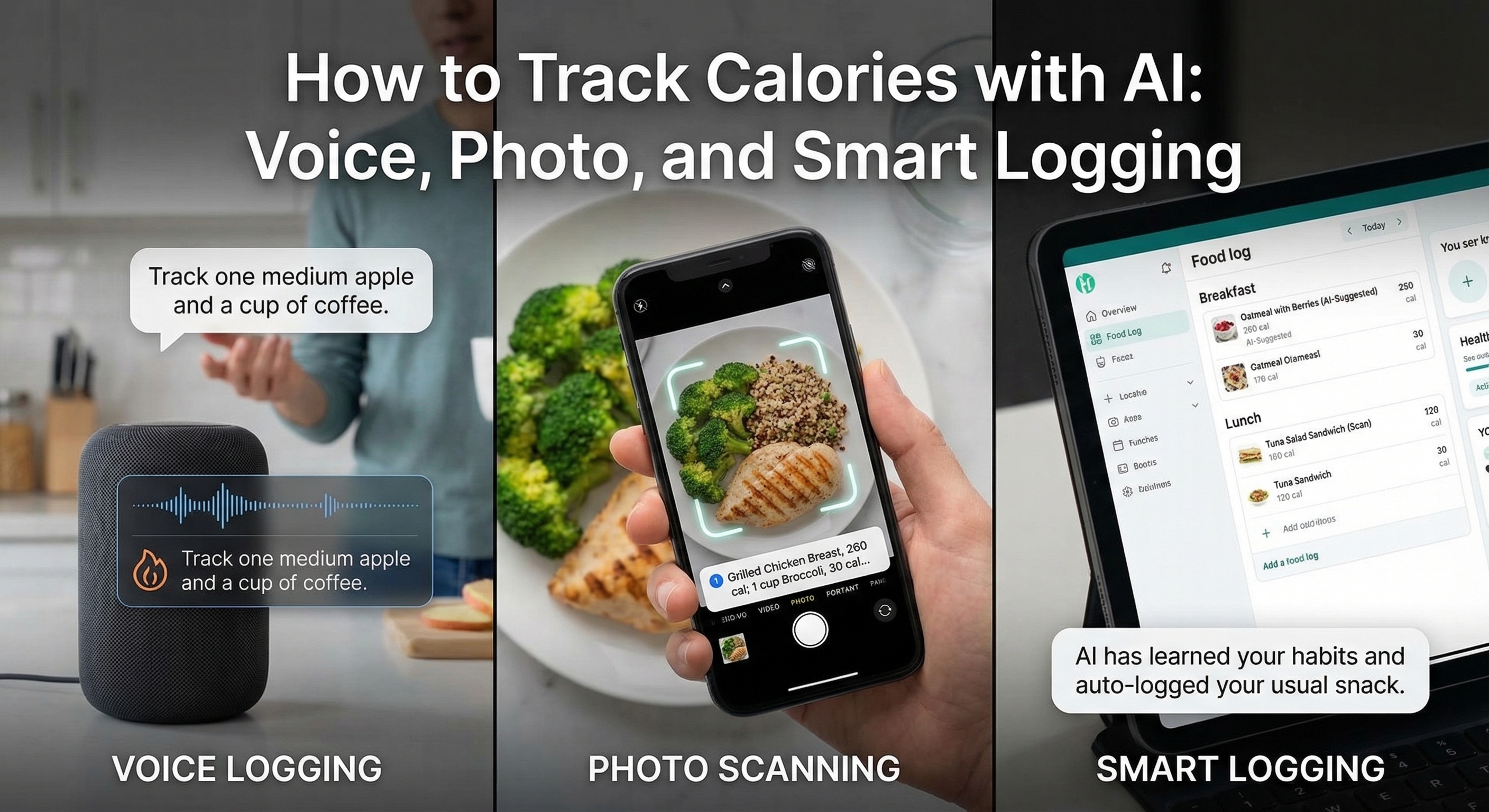
What Is AI Food Recognition?
AI food recognition is a branch of computer vision that identifies foods in photographs and estimates their nutritional content. Instead of scrolling through a database or typing "grilled chicken breast 6 oz," you snap a picture of your plate and receive a calorie and macronutrient breakdown within seconds.
The underlying models are trained on millions of labeled food images. During training, the network learns to associate visual patterns — color, texture, shape, plating style — with specific food items. When you submit a new photo, the model compares what it sees against those learned patterns, identifies each item on the plate, estimates portion sizes, and returns nutritional data.
This approach matters because the single biggest friction point in nutrition tracking is data entry. Studies consistently show that manual logging takes an average of 5–10 minutes per meal, and most people abandon the habit within two weeks. Photo-based tracking cuts that time to under 15 seconds.
According to a 2023 systematic review in the journal Nutrients, AI-based food recognition systems now achieve top-1 accuracy rates between 80% and 95% on standard food image datasets. This rapid improvement has made photo-based logging a viable replacement for manual entry in everyday use.
"AI-powered dietary assessment has the potential to fundamentally change how we approach nutritional epidemiology and personal health tracking, reducing the burden of manual logging while maintaining clinically useful accuracy." — Nutrients, 2023
How the Technology Works
Modern food recognition systems generally follow a multi-stage pipeline:
- Image Preprocessing: The raw photo is resized, normalized for lighting, and adjusted for white balance. This step ensures the model receives consistent input regardless of whether you shot under fluorescent kitchen lights or natural sunlight on a patio.
- Object Detection and Segmentation: The model identifies distinct food regions within the frame. A plate with rice, grilled salmon, and steamed broccoli gets split into three separate segments. Each segment is analyzed independently, which is critical for mixed plates where items overlap or touch.
- Classification: Each detected region is classified against a taxonomy of known foods. State-of-the-art models can distinguish between thousands of food items, including visually similar ones like white rice and cauliflower rice, or regular pasta and whole-wheat pasta.
- Portion Estimation: This is the hardest step. The model estimates how much of each food is present using visual cues like plate size, food depth, and known reference objects. Some systems use depth sensors or ask users to include a reference object (like a coin) for scale, while others rely purely on statistical modeling.
- Nutritional Lookup: Once the food and portion are identified, the system pulls nutritional data from a verified food composition database like the USDA FoodData Central — returning calories, protein, carbohydrates, fat, fiber, and often key micronutrients.
Accuracy and Limitations
No food recognition system is perfect. Understanding where AI excels — and where it struggles — helps you get the most out of photo-based tracking.
Where AI Performs Well
- Single-ingredient foods: A banana, a hard-boiled egg, or a plain chicken breast are recognized with high confidence.
- Common meals: Standard dishes like spaghetti Bolognese, Caesar salad, or a cheeseburger match well against training data.
- Packaged foods with barcodes: Many apps combine photo recognition with barcode scanning for packaged items, giving near-exact results.
Where AI Struggles
- Hidden ingredients: A smoothie might contain protein powder, peanut butter, and chia seeds that aren't visible in the photo.
- Heavily mixed dishes: Casseroles, stews, and burritos with multiple wrapped layers are harder to decompose.
- Uncommon regional foods: If the model hasn't been trained on a particular dish, it may misclassify it or default to a generic category.
- Portion ambiguity: Two photos of the same pasta dish can look identical even when one serving is 30% larger than the other.
A study published in the Journal of Medical Internet Research found that image-assisted dietary assessment reduced participant burden by over 50% compared to traditional methods, while maintaining comparable accuracy for energy and macronutrient estimation.
The best approach is to treat AI estimates as a strong starting point and adjust when you know the estimate is off — for example, if you measured your rice with a cup before plating.
Tips for Better Photo Recognition Results
Small adjustments to how you photograph your food can meaningfully improve accuracy:
- Shoot from above at a 45-degree angle. This gives the model the best view of all items on the plate without occlusion.
- Use good lighting. Natural daylight or a well-lit room reduces color distortion that can confuse the classifier.
- Separate items when possible. If your rice and curry are in separate bowls, photograph them individually or arrange them with clear boundaries.
- Include the full plate. Cropped images lose portion-size context. Keep the plate edges visible.
- Log before mixing. If you're about to stir dressing into a salad, snap the photo first when each component is identifiable.
These habits take seconds to adopt and can substantially improve the nutritional estimates you receive.
How NutriMind Uses AI Food Recognition
NutriMind integrates AI food recognition as a core logging method alongside barcode scanning, database search, and manual entry. When you photograph a meal, NutriMind's AI identifies each item, estimates portions, and logs the full macro and micronutrient breakdown to your daily tracker — typically in under 10 seconds.
Because the model handles the heavy lifting, you spend less time on data entry and more time on the choices that actually affect your health. If the AI gets something slightly wrong, you can tap any item to adjust it, and the app learns from your corrections over time.
If you've been putting off nutrition tracking because of the hassle, AI food recognition removes the biggest barrier. Try NutriMind free and see how much faster tracking can be when your camera does the work.
Written by Johnny
Founder of NutriMind and health-tech developer. Johnny builds AI-powered tools that make nutrition tracking faster and more accessible for everyone.
Connect on LinkedIn →Try NutriMind Free
AI-powered food tracking, barcode scanning, macro coaching, and more — available on iOS, Android, and web.