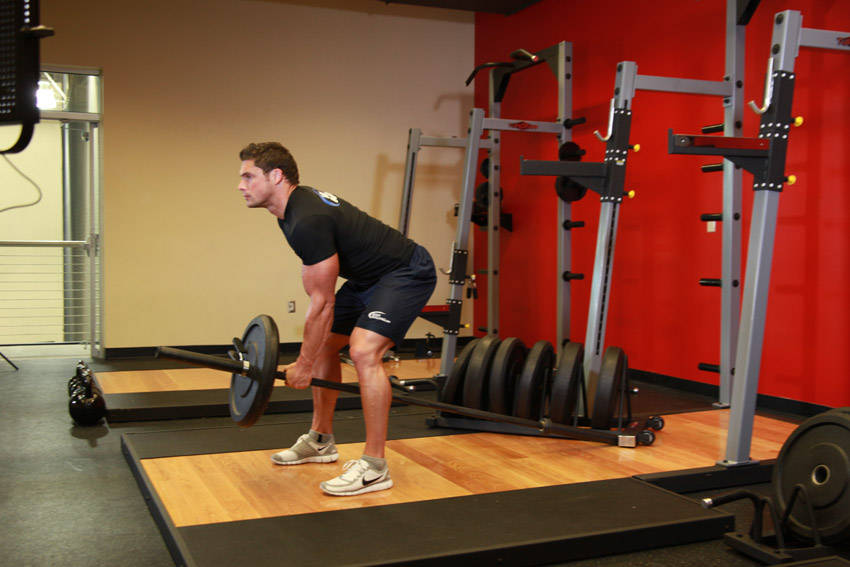
Bent Over One-Arm Long Bar Row
A back exercise targeting the middle back, performed with barbell.
Body part
BackEquipment
Barbell
Target muscles
Middle Back
Secondary muscles
Biceps, Lats, Lower Back, Traps
How to do Bent Over One-Arm Long Bar Row
Put weight on one of the ends of an Olympic barbell. Make sure that you either place the other end of the barbell in the corner of two walls; or put a heavy object on the ground so the barbell cannot slide backward.
Bend forward until your torso is as close to parallel with the floor as you can and keep your knees slightly bent.
Now grab the bar with one arm just behind the plates on the side where the weight was placed and put your other hand on your knee. This will be your starting position.
Pull the bar straight up with your elbow in (to maximize back stimulation) until the plates touch your lower chest. Squeeze the back muscles as you lift the weight up and hold for a second at the top of the movement. Breathe out as you lift the weight. Tip: Do not allow for any swinging of the torso. Only the arm should move.
Slowly lower the bar to the starting position getting a nice stretch on the lats. Tip: Do not let the plates touch the floor. To ensure the best range of motion, I recommend using small plates (25-lb ones) as opposed to larger plates (like 35-45lb ones).
Repeat for the recommended amount of repetitions and switch arms.
Muscles worked
Primary (target)
Secondary
Related exercises
Track Bent Over One-Arm Long Bar Row in NutriMind
Log your sets and the app does the rest — automatic PR detection, progression charts for every lift, and progressive overload that adjusts your next workout. Paired with AI nutrition coaching so your training and your plate pull in the same direction.
Planning your next heavy session? Estimate your max with the One Rep Max Calculator and build up to it with the Warm-up Calculator. More free tools →