Why Nutrition Decides Whether Your Lifts Move
Training is a request. Food is the answer. A hard squat session tells your body "build more muscle, get stronger" — but the building only happens if the raw materials (protein) and the energy budget (calories) show up. Miss either one and the request gets filed away unfulfilled, no matter how good the program is.
This is why lifters who track their training religiously but eat by feel so often stall. You can't out-train a 500-calorie accidental deficit. Undereat by that much on average — easy to do without noticing — and your body prioritizes keeping the lights on over adding muscle. Recovery drags, bar speed drops, and the program gets blamed for a problem the kitchen created. The reverse mistake is just as common: eating "big" without a target and discovering at the end of a bulk that most of the gain was fat.
The fix isn't complicated, but it is specific: a protein target matched to your goal, a calorie target matched to your phase, and enough carbohydrate to train hard. The rest of this article puts real numbers on all three.
Protein: The Non-Negotiable Number
Protein is the one macro with a hard floor. The International Society of Sports Nutrition position stand recommends 1.6 to 2.0 grams per kilogram of bodyweight per day for building and maintaining muscle in people who train — and where you sit in that range should follow your goal:
- Cutting: ~2.0 g/kg. In a calorie deficit, higher protein is what protects the muscle you've built. This is the top of the range for a reason — it's the phase where protein matters most.
- Building muscle: ~1.8 g/kg. A surplus is protein-sparing, so you don't need the maximum — but you're actively constructing tissue, so you need more than maintenance.
- Maintaining: ~1.6 g/kg. Enough to hold your muscle and support training at stable bodyweight.
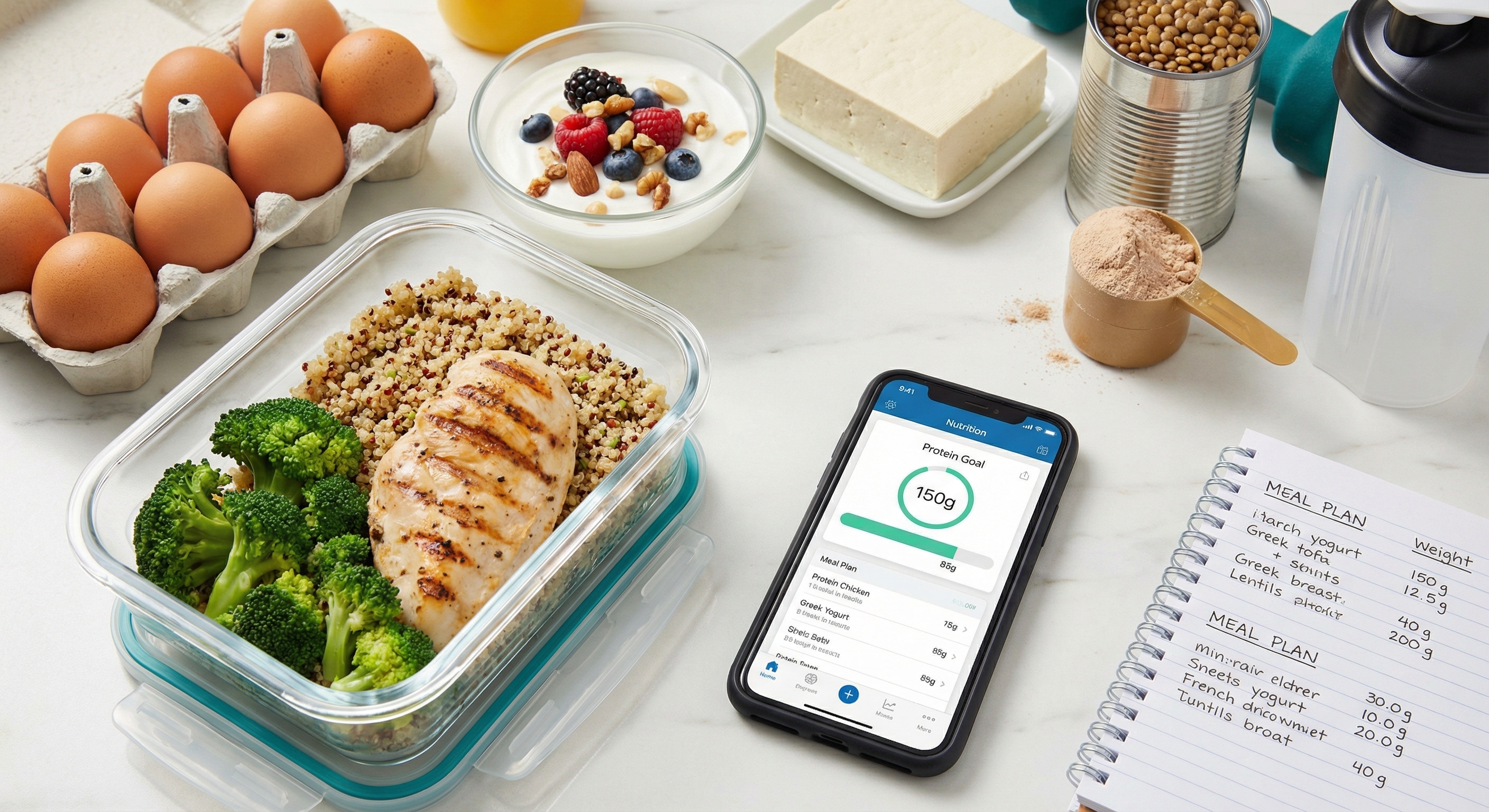
These are the same targets NutriMind's goal engine assigns, so your daily protein ring already reflects your current phase. For an 80 kg lifter, that's roughly 160 g on a cut, 145 g on a bulk, and 130 g at maintenance.
Distribution Matters Less Than the Total — But It Still Matters
Hitting the daily total is 90% of the battle. The remaining 10%: spread it across 3 to 5 meals of roughly 0.4 g/kg each (about 30–40 g for most lifters), so each meal triggers a fresh wave of muscle protein synthesis rather than front-loading one giant dinner.
Not sure what your number is? The free protein calculator computes your daily target by bodyweight and goal, with a per-meal distribution table included.
Calories by Phase: Cut, Recomp, or Lean Bulk
Every calorie target starts from your TDEE — total daily energy expenditure, the calories you burn in a day including training. Compute it once with the TDEE calculator, then pick a phase:
Cutting: Lose Fat, Keep Strength
Target a deficit that loses 0.5–1% of bodyweight per week — for an 80 kg lifter, that's 0.4–0.8 kg weekly, roughly a 400–800 calorie daily deficit. Faster than that and you start paying in muscle: research in athletes found that slower weight loss (~0.7% per week) preserved lean mass and even allowed strength gains, while faster loss (~1.4% per week) sacrificed both. Keep protein at 2.0 g/kg and keep lifting heavy — those two signals are what tell your body the muscle is still needed.
Maintenance / Recomp: Trade Fat for Muscle at Stable Weight
Eat at TDEE, keep protein high (1.6–2.0 g/kg), and train with progressive overload. The scale barely moves while body composition slowly improves. This works best for newer lifters and those returning from a layoff — more on realistic expectations below.
Lean Bulking: A Small, Deliberate Surplus
Add 200–300 calories above TDEE, targeting roughly 0.25–0.5% of bodyweight gained per month for intermediate lifters (novices can gain faster). Why so modest? Because muscle protein synthesis has a speed limit. A 1,000-calorie surplus doesn't build muscle four times faster than a 250-calorie surplus — it builds muscle at nearly the same rate and stores the difference as body fat, which you'll then spend months dieting back off.
Once you know your phase, the macro calculator turns it into a complete daily target — calories, protein, carbs, and fat — using the same formulas the app applies at onboarding.
Carbs Around Training: Fuel the Work
Carbohydrate is the fuel your sets actually run on. Lifting in the 5–12 rep range draws heavily on muscle glycogen — the stored carbohydrate inside the muscle itself — and training with chronically low glycogen shows up exactly where you'd expect: fewer quality reps, slower bar speed in the back half of a session, and workouts that feel harder than the load justifies.
Practical targets, consistent with the ISSN nutrient timing position stand:
- Daily baseline: 3–5 g/kg for most lifters (240–400 g for an 80 kg trainee), scaling with training volume. Cutting? Protein and a minimum fat intake get priority; carbs flex with the remaining budget.
- Pre-training: a meal with 1–2 g/kg of carbs and 20–40 g of protein 1–3 hours before lifting. Closer to the session, keep it smaller and easier to digest — a banana and yogurt beat a burrito 30 minutes out.
- Post-training: the "anabolic window" is wider than the supplement industry claimed — think hours, not minutes — but a normal meal with protein and carbs within a couple of hours of training is still the sensible default. Timing becomes genuinely important mainly when you train twice a day and need to refill glycogen fast.
The simplest mental model: put a meaningful share of your daily carbs in the meals before and after your session, and don't fear carbs at night — total daily intake drives results, not the clock.
Why Tracking Makes Progressive Overload Work
Progressive overload is an experiment you run on yourself: add a little load or a rep each week and watch whether your body adapts. But an experiment only produces readable results when the other variables are controlled — and nutrition is the biggest one.
If your intake silently swings from 2,200 calories on busy weekdays to 3,400 on weekends, your recovery is a different experiment every few days. A stalled lift could mean the program needs changing, or it could mean Tuesday through Thursday you were accidentally 500 calories under target. Without food data, you're guessing — and lifters usually guess "more volume" when the real answer was "more dinner."
Tracking closes the loop:
- It catches accidental deficits before they cost you a training block. Appetite is a terrible calorie sensor, especially during stressful weeks.
- It makes phases real. "Lean bulk" is a plan; 2,900 calories logged daily is an execution.
- It pairs with your training data. When your log shows both the squat that stalled and the three-week calorie dip that preceded it, the diagnosis writes itself.
The same logic applies on the training side — progress needs enough stimulus, not just enough food. The training volume calculator scores your weekly hard sets per muscle group against evidence-based landmarks, so you can check both halves of the equation.
A Worked Example: One Day for an 80 kg Intermediate Lifter
Meet our example lifter: 80 kg, intermediate, training four days a week, lean bulking. TDEE comes out around 2,650 calories; with a +250 surplus, the daily target is ~2,900 calories, ~160 g protein (2.0 g/kg), ~80 g fat, and ~390 g carbs. Here's what that actually looks like on a training day with a 5 p.m. session:
- Breakfast (7:30): 100 g oats cooked with milk, a banana, and 3 eggs. ≈700 kcal, 35 g protein. Slow carbs to start the day, first protein feeding.
- Lunch (12:30): 180 g chicken breast, 300 g cooked rice, mixed vegetables, a drizzle of olive oil. ≈850 kcal, 50 g protein. The biggest carb load of the day, four to five hours before training.
- Pre-training snack (3:30): Greek yogurt with granola and honey. ≈400 kcal, 20 g protein. Easy-digesting carbs 90 minutes out.
- Post-training shake (6:30): whey protein with a large apple. ≈300 kcal, 27 g protein. Fast protein while dinner cooks.
- Dinner (8:00): 170 g salmon, 350 g potatoes, big salad. ≈650 kcal, 38 g protein. Final protein feeding, glycogen topped back up for tomorrow.
Total: ≈2,900 calories and ≈170 g protein across five feedings of 20–50 g each. Notice what's not here: no exotic foods, no dry chicken and sadness — just a normal day of eating with protein anchored at every meal and carbs biased around the session. On rest days, the same lifter drops the pre-training snack and a portion of the rice, landing near maintenance.
Recomposition: What to Expect at Your Training Age
"Can I build muscle and lose fat at the same time?" Yes — but how much of each depends almost entirely on your training age.
- New lifters (0–1 year): recomposition is nearly the default. An untrained body responds so strongly to lifting that controlled studies have shown simultaneous muscle gain and fat loss even in a substantial deficit, provided protein is high (2.0+ g/kg) and training is hard. If this is you, don't agonize over bulk-versus-cut — eat near maintenance with high protein and let the newbie gains work.
- Intermediate lifters (1–3 years): recomp still happens, but slowly, and it demands tighter execution — consistent protein, calories within a couple hundred of maintenance, progressive training, and decent sleep. Expect visible change on the scale of months, not weeks. Returning lifters and those carrying higher body fat see the fastest results.
- Advanced lifters (3+ years): meaningful recomp is rare. This close to your genetic ceiling, the body needs a clearer signal: dedicated gaining phases and cutting phases, executed patiently, beat trying to do both at once.
The body recomposition calculator turns this into concrete numbers — calories, protein, and a realistic 12-week projection based on your stats and training experience.
One last thought. Strength-only apps can rank your lifts, but a ranking is a scoreboard, not a meal plan — your percentile moves because of what happens between sessions, and most of that is food. That's the gap NutriMind closes: workout logging, a strength score, and the nutrition tracking that feeds the climb, in one app. See how it stacks up against a strength-only tracker, or try NutriMind free and put your next training block on a proper budget.
Nutrition for Lifting FAQ
How much protein do I need to build muscle?
The evidence-based range is 1.6–2.0 g per kilogram of bodyweight per day, per the ISSN position stand — about 130–160 g for an 80 kg lifter. Sit near 1.8 g/kg when gaining, and push toward 2.0 g/kg when cutting, since higher protein protects muscle in a deficit. Spread it across 3–5 meals of 30–40 g each for best effect, but remember the daily total matters far more than perfect timing. The protein calculator gives you a personal number in seconds.
Should I bulk or cut first?
Go by body fat and goal. If you're carrying noticeable excess fat (roughly above 18–20% for men, 28–30% for women), cut first — you'll move better, your surplus calories will partition better afterward, and you'll be happier with how the bulk looks. If you're already lean, lean bulk first; cutting from an under-muscled starting point mostly makes you smaller. In the middle, and newer to training? Eat at maintenance with high protein and recomp — you'll likely do both at once.
Can I build muscle in a calorie deficit?
Yes, under the right conditions: you're relatively new to lifting, returning after a layoff, or carrying higher body fat — and you keep protein high (around 2.0–2.4 g/kg) while training with progressive overload. Studies have demonstrated simultaneous fat loss and muscle gain in exactly these populations. The more advanced and leaner you get, the harder it becomes, until dedicated phases work better. Keep the deficit moderate (0.5–1% of bodyweight per week); aggressive deficits cost muscle at any training age.
What should I eat before lifting?
With 1–3 hours to digest: a normal meal with 1–2 g/kg of carbs and 20–40 g of protein — rice and chicken, oats and eggs, a sandwich and yogurt. Under an hour out: keep it small and fast-digesting, like a banana with a scoop of whey. Training fasted won't ruin a session, but most lifters get measurably better work done with carbs on board. Skip heavy fat and fiber right before lifting; they sit in your stomach through your warm-up sets.
Do I need different macros on rest days?
Not necessarily. Keeping the same target every day is simpler and works fine — recovery and muscle building happen on rest days, so they're not "wasted" calories. If you prefer to cycle, hold protein constant and pull 200–400 calories of carbs on rest days. Choose whichever version you'll actually stick to; consistency beats optimization here.
Written by Johnny
Founder of NutriMind and health-tech developer. Johnny builds AI-powered tools that make nutrition tracking faster and more accessible for everyone.
Connect on LinkedIn →Try NutriMind Free
AI-powered food tracking, barcode scanning, macro coaching, and more — available on iOS, Android, and web.