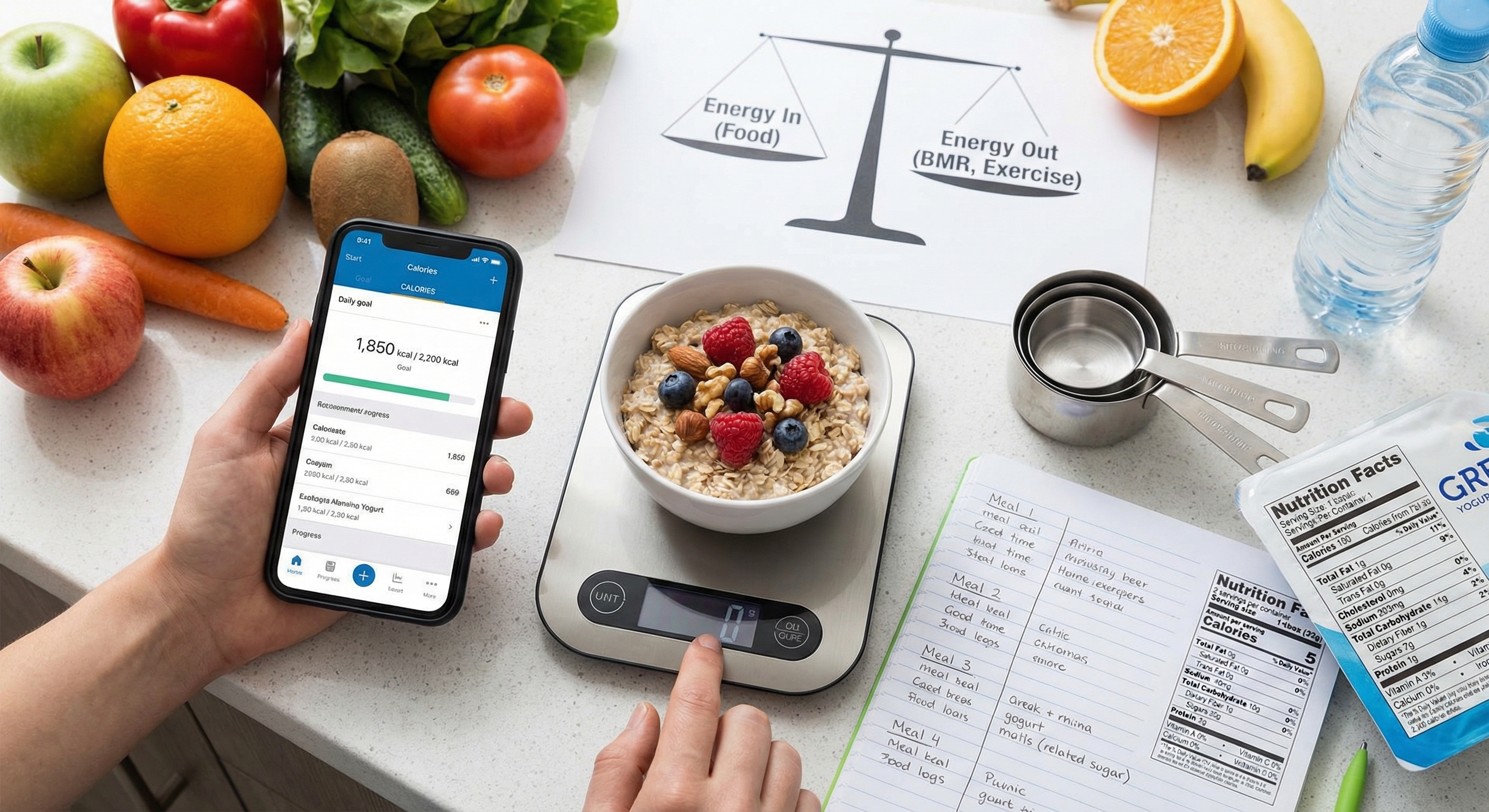
What Is Calorie Counting and Why Does It Work?
Calorie counting is the practice of tracking the energy content of everything you eat and drink throughout the day. A calorie is a unit of energy — specifically, the amount of energy needed to raise the temperature of one gram of water by one degree Celsius. Your body needs a certain number of calories each day to fuel basic functions like breathing, circulating blood, and repairing cells, plus additional energy for movement and exercise.
Calorie counting works because of a fundamental principle of energy balance: when you consume fewer calories than your body uses, you lose weight. When you consume more, you gain weight. This isn't a fad or a theory — it's thermodynamics applied to human biology. Every successful diet, whether it's keto, paleo, Mediterranean, or intermittent fasting, ultimately works by creating a calorie deficit, even if it doesn't explicitly ask you to count calories.
A landmark 2009 study published in the New England Journal of Medicine followed 811 overweight adults across four different diets with varying macronutrient compositions and found that all groups lost similar amounts of weight after two years — the determining factor was total calorie reduction, not the specific diet type.
The reason calorie counting remains one of the most popular approaches is its flexibility. You don't have to eliminate food groups or follow rigid meal plans. You simply need awareness of how much energy you're consuming relative to how much you're using. That awareness alone changes behavior — people who track calories naturally gravitate toward more nutrient-dense, less calorie-dense foods because those foods let them eat more volume without exceeding their target.
"Self-monitoring of dietary intake is consistently one of the strongest predictors of successful weight management. The act of recording food intake increases awareness and accountability, which directly influences food choices." — Dr. Jack Hollis, Senior Investigator, Kaiser Permanente Center for Health Research
How to Calculate Your TDEE
Your Total Daily Energy Expenditure (TDEE) is the total number of calories your body burns in a day. It's the starting point for any calorie counting plan because you need to know how much energy you use before you can decide how much to eat. TDEE consists of three components:
- Basal Metabolic Rate (BMR): The calories your body burns at complete rest — just to keep your organs functioning, your heart beating, and your lungs breathing. BMR accounts for roughly 60–70% of total daily expenditure for most people.
- Thermic Effect of Food (TEF): The energy required to digest, absorb, and process the food you eat. This accounts for about 10% of calorie intake. Protein has the highest thermic effect (20–30%), followed by carbohydrates (5–10%) and fat (0–3%).
- Activity and Exercise: All movement, from walking to the kitchen to an hour of weightlifting. This is the most variable component and the one you have the most control over.
The most widely validated formula for estimating BMR is the Mifflin-St Jeor equation, which has been shown to estimate resting metabolic rate within 10% for most individuals:
- Men: BMR = (10 × weight in kg) + (6.25 × height in cm) − (5 × age in years) + 5
- Women: BMR = (10 × weight in kg) + (6.25 × height in cm) − (5 × age in years) − 161
Once you have your BMR, multiply it by an activity factor to get your TDEE:
- Sedentary (desk job, little exercise): BMR × 1.2
- Lightly active (1–3 days of exercise per week): BMR × 1.375
- Moderately active (3–5 days of exercise per week): BMR × 1.55
- Very active (6–7 days of exercise per week): BMR × 1.725
- Extremely active (physical job + daily hard training): BMR × 1.9
Example: A 30-year-old man who weighs 80 kg, stands 178 cm tall, and exercises 3–4 times per week would have a BMR of approximately 1,780 calories and a TDEE of about 2,760 calories (1,780 × 1.55).
Remember that TDEE calculators provide estimates, not exact numbers. Use your calculated TDEE as a starting point and adjust based on real-world results over two to three weeks.
How to Set a Calorie Target
Once you know your TDEE, setting your daily calorie target depends on your goal — fat loss, maintenance, or muscle gain.
For Fat Loss (Calorie Deficit)
To lose body fat, eat fewer calories than your TDEE. A moderate deficit of 300–500 calories per day is recommended for sustainable fat loss. This translates to losing roughly 0.25–0.5 kg (0.5–1 lb) of body fat per week, which is the rate most health professionals consider safe and maintainable.
Aggressive deficits (750–1,000+ calories below TDEE) can accelerate weight loss but come with trade-offs: increased muscle loss, metabolic adaptation, reduced energy, impaired recovery, and a much higher risk of rebound weight gain. Research from the International Journal of Obesity (2015) found that individuals who lost weight at a moderate pace retained 18% more lean mass compared to rapid weight-loss groups, even when total weight lost was similar.
For Maintenance
If you're happy with your current weight and body composition, eat at your TDEE. Tracking at maintenance is still valuable — it builds food awareness and helps prevent gradual calorie creep that leads to unintentional weight gain over months and years.
For Muscle Gain (Calorie Surplus)
To build muscle, eat 200–400 calories above your TDEE while following a structured resistance training program. A modest surplus minimizes fat gain while providing enough energy for muscle growth. Going much higher typically just adds more body fat without accelerating muscle synthesis.
Floor Guidelines
Regardless of your goal, most nutrition professionals recommend that women do not consistently eat below 1,200 calories per day and men do not go below 1,500 calories per day without medical supervision. Going below these thresholds makes it very difficult to meet micronutrient needs and can impair metabolic function.
Practical Methods for Counting Calories
There are several approaches to tracking your daily intake, and the best method is the one you'll actually stick with.
1. App-Based Tracking
Mobile apps are the most popular and efficient method for calorie counting. They offer searchable food databases with hundreds of thousands of entries, barcode scanners for packaged foods, and AI photo recognition for quick logging. Most apps also calculate running totals and show how close you are to your daily target throughout the day.
2. Nutrition Labels
For packaged foods, the nutrition facts panel provides exact calorie counts per serving. The key is to always check the serving size and compare it to how much you actually eat. If the label says 200 calories per 50g serving and you eat 75g, your actual intake is 300 calories.
3. Food Scale
A digital kitchen scale (typically under $15) is the most accurate tool for portion measurement. Weighing your food for even two weeks dramatically improves your ability to estimate portions by eye going forward. This is especially important for calorie-dense foods like nuts, oils, cheese, and grains where a small difference in portion size means a large difference in calories.
4. Measuring Cups and Spoons
Less precise than a scale but better than eyeballing. Useful for liquids, grains, and other pourable foods. Keep in mind that a heaping tablespoon of peanut butter can contain nearly double the calories of a level one.
5. Restaurant and Recipe Estimation
When eating out, check the restaurant's website for nutritional information (many chains now provide it), or search for similar dishes in your app's database. For homemade recipes, many apps let you input individual ingredients and serving count to calculate per-serving calories automatically.
A 2018 study published in Obesity tracked 1,696 participants and found that those who logged their food most frequently lost nearly twice as much weight as infrequent loggers — and that by month six, the average time spent logging had dropped to just 14.6 minutes per day as the habit became routine.
Common Calorie Counting Mistakes to Avoid
Calorie counting is simple in concept but easy to get wrong in practice. Here are the most common pitfalls and how to avoid them:
- Forgetting cooking oils and fats. A tablespoon of olive oil adds 119 calories and 14g of fat. If you cook with oil twice a day and don't log it, you're missing 200–300 calories daily — enough to erase a calorie deficit entirely.
- Ignoring liquid calories. Coffee drinks, juices, sodas, smoothies, and alcohol contribute real calories that many people forget to track. A large latte with syrup can contain 300+ calories. A glass of wine adds 125. These add up quickly.
- Relying on round numbers. Logging "a chicken breast" without specifying weight can mean anything from 120 to 350 calories. Always reference a specific weight or use verified database entries with defined portions.
- Eating back exercise calories. Fitness trackers and cardio machines routinely overestimate calorie burn by 20–40%. If you ate 400 "extra" calories because your watch said you burned 400 on the treadmill, you may have actually only burned 250 — wiping out your deficit.
- Weekend amnesia. Many people track diligently Monday through Friday and then stop on weekends, which is precisely when intake tends to spike. Two untracked days of overconsumption can offset five days of adherence.
- Seeking perfection over consistency. Some people abandon calorie counting entirely after one inaccurate day. In reality, an imperfect log is far more valuable than no log. Even rough tracking keeps you aware and accountable.
- Setting the target too low. Extreme calorie restriction is not sustainable and can trigger metabolic adaptation, binge eating cycles, and nutrient deficiencies. A moderate deficit maintained consistently always outperforms a severe deficit maintained sporadically.
Using NutriMind to Count Calories
NutriMind is designed to make calorie counting as fast and friction-free as possible. During onboarding, the app calculates your personalized calorie and macro targets based on your age, weight, height, activity level, and goal — so you start with a scientifically grounded target from day one.
For daily logging, NutriMind gives you multiple options to suit any situation:
- AI photo recognition: Snap a photo of your meal and NutriMind identifies each food, estimates portions, and logs the calories automatically — typically in under 10 seconds.
- Barcode scanning: Scan any packaged food for an exact nutritional breakdown pulled from verified databases.
- Database search: Search from hundreds of thousands of food entries with detailed portion options.
- Quick-add and favorites: Save your most common meals and re-log them with a single tap.
The app tracks your running calorie total throughout the day with a clear visual progress bar, making it easy to see exactly where you stand at any moment. NutriMind's AI Macro Coach can also answer questions about your intake, suggest adjustments, and help you plan your remaining meals to hit your target.
If you're ready to start counting calories without the hassle, try NutriMind free and discover how much easier tracking can be when the technology handles the tedious parts for you.
Written by Johnny
Founder of NutriMind and health-tech developer. Johnny builds AI-powered tools that make nutrition tracking faster and more accessible for everyone.
Connect on LinkedIn →Try NutriMind Free
AI-powered food tracking, barcode scanning, macro coaching, and more — available on iOS, Android, and web.

