The 2025-2030 Dietary Guidelines Changed Everything
In late 2025, the USDA and HHS released the 2025-2030 Dietary Guidelines for Americans, and the language around sugar was unprecedented. For the first time, the federal government stated that "no amount of added sugars is part of a healthy dietary pattern." That's not a soft recommendation — it's a line in the sand.
The new guidelines also introduced a per-meal cap: no more than 10 grams of added sugar per meal. To put that in perspective, a single tablespoon of ketchup has about 4 grams. A flavored yogurt can hit 15 grams before you even start your day.
This shift didn't come out of nowhere. The science has been building for years. CDC data shows that Americans consume an average of 17 teaspoons — roughly 71 grams — of added sugar every day. That's nearly triple what most health organizations recommend.
Speaking of recommendations, here's where the major organizations stand:
- American Heart Association (AHA): No more than 25 grams per day for women, 36 grams per day for men.
- World Health Organization (WHO): Under 10% of total daily calories from free sugars, ideally under 5%.
- 2025-2030 Dietary Guidelines: Zero added sugar as the ideal, with a ceiling of 10 grams per meal if you do consume it.
The consensus is clear and getting stricter. Harvard's Nutrition Source has been sounding the alarm for years, linking excess added sugar to heart disease, type 2 diabetes, fatty liver disease, and obesity — independent of total calorie intake.
This is why tracking sugar matters now more than ever. You can't manage what you don't measure, and most people have no idea how much sugar they're actually consuming.
Total Sugar vs. Added Sugar: What's the Difference?
Before you start tracking, you need to understand the distinction between total sugar and added sugar — because they are not the same thing, and confusing them leads to bad decisions.
Total sugar is everything: the naturally occurring sugars found in whole fruits, vegetables, and dairy, plus any sugars added during manufacturing or preparation. When you see "Total Sugars" on a nutrition label, that's the combined number.
Added sugar is only the sugar that was introduced during processing. This includes high fructose corn syrup, cane sugar, brown rice syrup, agave nectar, and yes — even honey when it's used as an ingredient in a manufactured product. The FDA has required "Added Sugars" on US nutrition labels since 2020, making it much easier to spot.
Why does the distinction matter? Because the metabolic effects are dramatically different.
When you eat a whole apple, you're getting about 19 grams of natural sugar. But that sugar arrives packaged with 4.4 grams of fiber, water, vitamins, and polyphenols. The fiber slows digestion, prevents a blood sugar spike, and feeds your gut microbiome. Your body handles it well.
Now take apple juice concentrate used as a sweetener in a granola bar. It's the same sugar molecule — fructose and glucose — but stripped of fiber and micronutrients. It hits your bloodstream fast, spikes insulin, and delivers none of the protective compounds that came with the original fruit. Same molecule, completely different context.
"The sugar in whole fruit is not the problem. It's the sugar that's been extracted, concentrated, and added to processed foods that drives metabolic disease." — Harvard T.H. Chan School of Public Health
Here's the practical challenge: added sugar data isn't always available. Restaurant meals, homemade dishes, and many international food databases don't separate added from natural sugar. That's why tracking total sugar is the more reliable day-to-day approach. It gives you a complete picture, and if your total sugar is low, your added sugar is necessarily low too.
How Much Sugar Should You Eat Per Day?
The short answer depends on which guidelines you follow, but they all point in the same direction: most people are eating far too much.
Here's what the major health organizations recommend for added sugar:
- AHA: 25 grams per day for women (about 6 teaspoons), 36 grams per day for men (about 9 teaspoons).
- WHO: Under 10% of total daily energy intake — roughly 50 grams on a 2,000-calorie diet. Ideally under 5%, which works out to about 25 grams.
- 2025-2030 Dietary Guidelines: A maximum of 10 grams of added sugar per meal, with zero as the stated ideal.
To understand how easy it is to blow past these limits, consider a few common foods:
- Banana: ~14g of sugar (all natural — not a concern in a balanced diet)
- Can of Coca-Cola (12 oz): 39g of added sugar — that's your entire AHA daily limit for men in one can
- Starbucks Caramel Frappuccino (Grande): 50g+ of added sugar — double the AHA limit for women
- Flavored yogurt (6 oz): ~12g of sugar (mix of natural dairy sugar and added)
- Granola bar: 8-15g of added sugar, depending on the brand
- Pasta sauce (half cup): 6-12g of added sugar — and most people use more than half a cup
A single breakfast of flavored yogurt with granola and a glass of orange juice can easily put you at 40+ grams of sugar before noon. That's not a junk food breakfast — it's what many people consider healthy.
An important nuance: these limits are for added sugar, not total sugar. The sugar in a banana or a handful of blueberries isn't the problem. Whole fruits come with fiber, water, and micronutrients that fundamentally change how your body processes that sugar. No credible health organization is telling you to stop eating fruit.
The real danger is the added sugar hiding in foods that don't even taste sweet — bread, pasta sauce, salad dressing, and "healthy" snack bars. That's where tracking becomes essential.
How to Track Sugar Intake: Step by Step
You don't need a nutrition degree to track sugar effectively. These five steps will get you from "I have no idea how much sugar I eat" to "I know exactly where I stand" within a week.
-
Read nutrition labels — every time.
Start with the Nutrition Facts panel. Look for two lines: "Total Sugars" and "Includes X g Added Sugars" (indented below). The added sugars line tells you exactly how much sugar was put there by the manufacturer. Make this a habit for every packaged food you buy — you'll be shocked at where sugar hides.
-
Use an app that tracks sugar automatically.
Manual tracking is tedious and unsustainable for most people. A nutrition tracking app with photo scanning, barcode scanning, or text-based logging will capture sugar alongside every other nutrient — no extra effort required. If the app tracks calories and macros, it's almost certainly tracking sugar too.
-
Check your daily total, not individual foods.
A piece of dark chocolate at 8 grams of sugar isn't a problem if your daily total is 30 grams. Obsessing over individual items leads to unnecessary food guilt. What matters is where you land at the end of the day. Check your daily summary after dinner and you'll quickly learn which patterns keep you in range.
-
Focus on patterns, not perfection.
One high-sugar day at a birthday party doesn't derail your health. What matters is your weekly average. If you're at 35 grams of added sugar most days and hit 70 on Saturday, your weekly average is still reasonable. Tracking apps that show weekly trends are far more useful than ones that only show today.
-
Use the sugar-to-carbs ratio as a quality indicator.
This is an underrated metric. If you eat 250 grams of carbohydrates in a day and 80 of those grams come from sugar, your carb quality is low — most of your carbs are simple sugars rather than complex carbs from whole grains, legumes, and vegetables. A lower sugar-to-carb ratio generally means higher diet quality. NutriMind's sugar card displays this ratio visually, so you can see at a glance whether your carbs are working for you or against you.
The goal isn't perfection — it's awareness. Most people who start tracking sugar are surprised by how much they consume and naturally start making better choices without any rigid dieting.
Tools That Make Sugar Tracking Effortless
The right tool makes the difference between tracking for two days and tracking for two months. Here's what to look for — and what separates the good options from the rest.
Photo scanning is the fastest way to log sugar without thinking about it. Point your camera at a plate of food, and AI estimates sugar alongside calories, protein, carbs, and fat. No manual entry, no searching through databases. The sugar data just shows up in your daily log.
Barcode scanning is even more precise for packaged foods. Scan the barcode on a cereal box or protein bar, and the app pulls the full nutrition panel — including total sugars and added sugars — directly from the product database. This is the most accurate method for anything with a label.
Nutrition label scanning takes it a step further. Instead of just the barcode, you photograph the actual Nutrition Facts panel. The app reads each line using OCR, including the "Includes X g Added Sugars" line that the FDA now requires. This is especially useful for local or store-brand products that aren't in barcode databases.
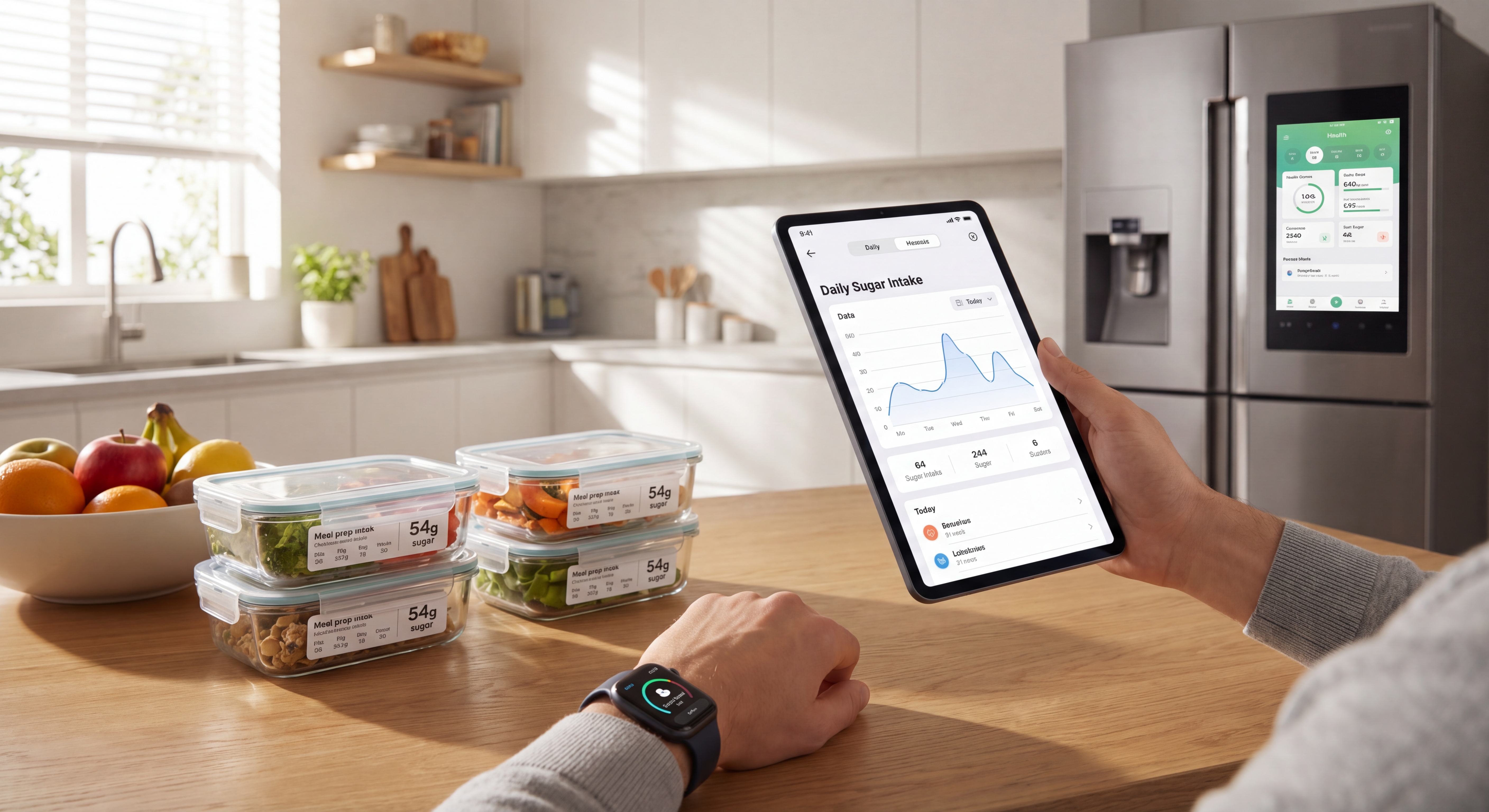
Dashboard visualization turns raw numbers into something actionable. Seeing sugar as a proportion of your total carbohydrates — or as a daily trend line over the past week — is far more useful than a single number in a table. Good visualization answers the question "Am I on track?" in one glance.
Reports and exports let you track sugar trends over weeks and months. This is where real behavior change happens. When you can see that your Tuesday sugar intake is consistently higher (maybe it's Taco Tuesday with margaritas), you can make targeted adjustments.
NutriMind combines all five of these features — photo scanning, barcode scanning, label scanning, dashboard visualization, and weekly reports — in a single app. Most popular calorie tracking apps like MyFitnessPal bury sugar data or don't display it prominently. If sugar is something you care about tracking, make sure the tool you choose puts it front and center, not hidden three taps deep.
Sugar Tracking FAQ
Is fruit sugar bad for you?
No. Whole fruit sugar comes packaged with fiber, water, vitamins, and phytonutrients that fundamentally change how your body processes it. The fiber slows absorption, preventing the blood sugar spike you get from added sugars. The WHO guidelines and the 2025-2030 Dietary Guidelines both target added sugars, not the sugar in whole fruits. Eat your fruit. Just don't drink it as juice with the fiber stripped out.
Should I track total sugar or added sugar?
Track total sugar. Added sugar data simply isn't available for most foods — restaurants don't provide it, homemade meals don't have labels, and many food databases outside the US don't separate the two. Total sugar gives you a complete and consistent number every day. If your total sugar is within a reasonable range and most of it comes from whole foods like fruit and dairy, you're in good shape.
How accurate is AI sugar estimation?
AI estimates sugar with the same accuracy it estimates other macronutrients — protein, carbs, and fat. The models analyze food from the same image and estimate all nutrients in a single pass. Published research shows AI-based dietary assessment achieves 80-95% accuracy on standard food datasets. Sugar isn't any harder to estimate than carbs; it's part of the same nutritional profile.
What if I go over the daily limit?
Nothing catastrophic happens. One high-sugar day doesn't cause metabolic damage — it's the long-term pattern that matters. Look at your weekly average instead of fixating on a single day. If your weekly average is trending in the right direction, you're doing well. Research consistently shows that consistency over time beats perfection on any given day.
Do I need to set a sugar goal?
Not necessarily. For most people, awareness is the first step — and often the only step you need. Simply seeing your daily sugar total in black and white changes behavior. You start noticing which foods spike the number and naturally reach for alternatives. If you want a concrete target, the AHA's 25-36 gram daily limit for added sugar is a well-supported starting point. But don't let the absence of a goal stop you from tracking — the data itself is valuable.
Written by Johnny
Founder of NutriMind and health-tech developer. Johnny builds AI-powered tools that make nutrition tracking faster and more accessible for everyone.
Connect on LinkedIn →Try NutriMind Free
AI-powered food tracking, barcode scanning, macro coaching, and more — available on iOS, Android, and web.