What Maintenance Calories Actually Are
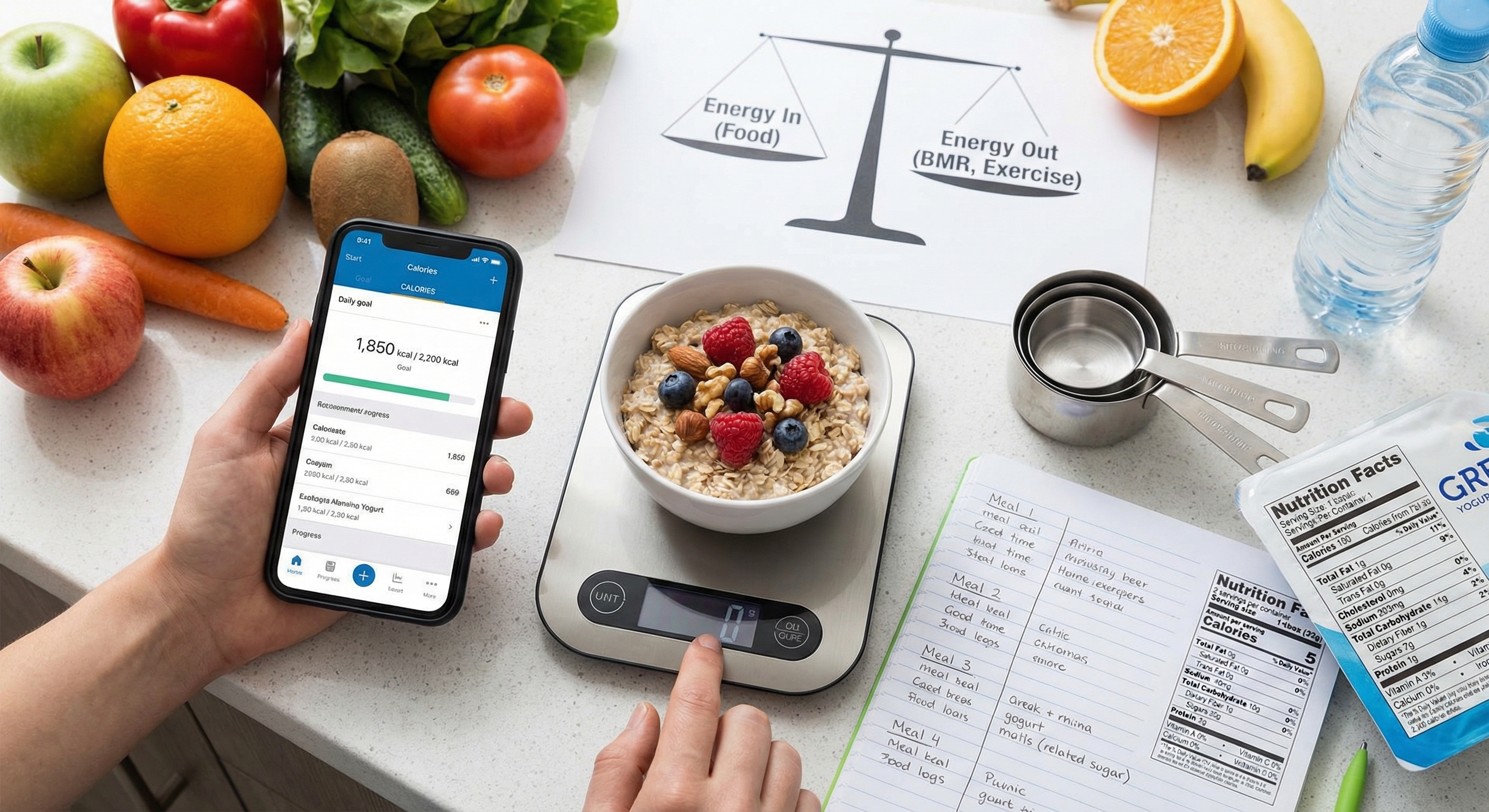
Your maintenance calories are the daily intake at which your weight holds steady — you're neither storing energy nor pulling from reserves. It goes by a few names: total daily energy expenditure, TDEE, or just "maintenance." They all describe the same thing: everything your body spends in 24 hours.
This is the number every other nutrition target is defined against. A cut is maintenance minus something. A lean bulk is maintenance plus something. Body recomposition is roughly maintenance with high protein and hard training. Even "just eating normally" is a bet about where maintenance sits.
Which makes it the most consequential number in your plan — and the one most people never actually determine. They take a calculator's output, subtract 500, and then spend months confused about why the arithmetic isn't behaving. If the reference point is wrong by 300 calories, every target built on it is wrong by 300 calories.
The Four Things Your Body Spends Energy On
Maintenance isn't one process, it's four — and knowing their relative sizes changes what you do about them.
Basal metabolic rate (BMR) — roughly 60–70%. What you'd burn lying still all day: heart, lungs, kidneys, liver, brain, and holding your temperature steady. The biggest slice by far, and mostly determined by how much of you there is. Lean mass is more metabolically active than fat mass, which is part of why two people at the same bodyweight can have different BMRs — though the difference is smaller than the internet suggests. Muscle burns roughly 13 calories per kilogram per day at rest, not the 50 you'll see quoted.
Non-exercise activity thermogenesis (NEAT) — typically 15–30%. Everything you do that isn't deliberate exercise: walking to the car, standing, cooking, fidgeting, gesturing while you talk. This is the wild card. Research on non-exercise activity has found differences of several hundred calories a day between people of similar size, driven almost entirely by unconscious movement. It's also the component that changes most when you diet — see below.
Thermic effect of food (TEF) — about 10%. Digesting, absorbing and storing what you eat costs energy. Protein is the most expensive at roughly 20–30% of its own calories, carbs around 5–10%, fat under 5%. A high-protein diet genuinely raises your expenditure a little — one of several reasons protein is worth prioritising.
Exercise activity (EAT) — usually 5–15%. Your actual workouts. For most people, even committed gym-goers, this is the smallest slice. Four hard hours a week might be 1,200–1,600 calories against a weekly maintenance near 18,000.
The practical lesson: the parts you can move most are NEAT and food, not training. Training matters enormously for what you keep while dieting — muscle — but it's a minor lever on the total.
Method 1: Estimate It With an Equation
The standard approach estimates your BMR from a formula, then multiplies by an activity factor.
- Mifflin-St Jeor — the current default, and the most accurate of the general-population equations. Uses height, weight, age and sex.
- Harris-Benedict — older, still widely implemented, tends to run slightly high.
- Katch-McArdle — uses lean body mass instead of total weight, so it's the better choice if you have a reliable body-fat figure. With a guessed body-fat percentage it's worse than Mifflin-St Jeor, not better. The lean body mass calculator works out the input.
Then comes the activity multiplier, and this is where estimates go wrong. The steps typically run: sedentary 1.2, lightly active 1.375, moderately active 1.55, very active 1.725. On a 1,600-calorie BMR, moving one step is roughly a 280-calorie swing — and the labels are vague enough that almost everyone rounds themselves up. "I train four times a week" feels moderately active, but if the other twenty hours of your day are spent at a desk and in a car, sedentary-to-lightly-active is closer to the truth.
Even with the right multiplier, individual variation around these equations runs to about ±10%. On 2,500 calories that's a 500-calorie band — wide enough to be the whole difference between losing and maintaining.
The TDEE calculator gives you this estimate quickly. Use it as a starting point, and then do the thing that actually gets you a real number.
Method 2: Measure It From Your Own Data
Equations estimate you from a population. Your own data measures you — including your NEAT, your job, your sleep, your genetics and your particular habits. It takes two to three weeks and it's worth every day.
1. Eat normally and log everything. Don't try to improve your diet yet. You're taking a baseline measurement, and changing behaviour mid-measurement ruins it. Log everything — cooking oil, drinks, the handful while cooking. A barcode scanner removes the guesswork on packaged food.
2. Weigh yourself daily, same conditions. First thing in the morning, after the bathroom, before eating or drinking. Daily swings of a kilogram from sodium, hydration and food in transit are normal and mean nothing individually.
3. Compare weekly averages, not days. After 14–21 days, average your daily calories, then average your weight for the first week and for the last.
4. Do the arithmetic. If your weight held steady, your average intake is your maintenance. If you lost about 0.5 kg (1 lb) per week, add roughly 500 calories to that average to find maintenance. If you gained at that rate, subtract 500.
The one thing that breaks this is inaccurate logging, and the research is blunt about how common that is: studies of self-reported intake routinely find people underestimate by 20% or more. It isn't dishonesty — it's untracked oil, generous portion estimates and forgotten drinks. Weighing your food for these two weeks, even if you never do it again, recalibrates your eye permanently.
A practical middle path is to start from the equation and let real data correct it. NutriMind's adaptive TDEE works this way — it compares your logged intake against your actual weight trend and refines its estimate of your maintenance as evidence accumulates. It deliberately stays an estimate that you can act on: it surfaces the better number rather than silently moving your targets underneath you.
Why Your Maintenance Keeps Moving
Find your maintenance once and you haven't found it forever. It drifts, which is why "the calculator stopped working" is such a common complaint.
Losing weight lowers it. A smaller body costs less to run and less to move. Drop 10 kg and you may lose 100–150 calories of maintenance from size alone — before anything else.
NEAT falls when you diet. In a deficit people unconsciously move less: fewer steps, less fidgeting, more sitting. This happens without any decision on your part and can account for a few hundred calories a day. It's the single largest contributor to a stalling deficit.
Adaptive thermogenesis adds a bit more. Sustained dieting produces a modest extra reduction beyond what size predicts — typically on the order of 5–15%. It's real, and it is nothing like the "destroyed metabolism" the internet describes. It also substantially reverses when you eat at maintenance again.
Gaining muscle raises it, slowly. Real but small: a kilogram of muscle adds roughly 13 calories a day. Over years of training the cumulative effect is meaningful; over one gaining phase it's minor. The bigger effect is that training makes you move and eat differently.
Age, seasons and life. Metabolic rate is now understood to be remarkably stable from roughly 20 to 60, with the decline arriving later than the folklore claims — much of what people attribute to age is a slow drop in activity. Injuries, desk jobs, new babies and winter all move NEAT more than birthdays do.
Practical rule: recalculate every 4–6 weeks, or any time you've lost about 5% of your bodyweight.
What to Do Once You Know It
Maintenance is a reference point, not a target — though eating at it is sometimes exactly the right call.
To lose fat: sit 15–25% below it, aiming for 0.5–1% of bodyweight per week. The full reasoning, including how to size the deficit and why the scale misbehaves early, is in calorie deficit explained.
To gain muscle: 5–15% above it. A surplus larger than that adds fat faster than your body can build muscle — the ceiling on muscle gain is biological, not caloric.
To recomp: at or very near maintenance, with protein at 1.6–2.0 g per kilogram and progressive training. Works best for newer lifters, returners, and those carrying more body fat. The body recomposition calculator estimates what's plausible for you.
To hold your result: eat at maintenance deliberately. This is the phase almost everyone skips, and it's why so much lost weight comes back. Finishing a cut and returning to "however I used to eat" restores the surplus that created the problem. Maintenance is a skill worth practising on purpose.
Whichever you pick, set the macro split with the macro calculator and your protein floor with the protein calculator.
Frequently Asked Questions
How do I calculate my maintenance calories?
Two ways. Fast: use the TDEE calculator, which estimates your basal rate and multiplies by an activity factor. Accurate: log your intake for two to three weeks while weighing yourself daily, then compare weekly averages — the intake that held your weight steady is your maintenance. The equation gets you started in seconds; your own data gets you the real number.
What's the difference between BMR and TDEE?
BMR is what you'd burn doing nothing at all — organs, brain, breathing, temperature — and accounts for 60–70% of the total. TDEE is BMR plus everything else: everyday movement, digesting food, and exercise. You eat to your TDEE, not your BMR; targeting BMR would put most people in a severe unintentional deficit.
Why is my TDEE different on every calculator?
Different sites use different equations (Mifflin-St Jeor, Harris-Benedict, Katch-McArdle) and different activity multipliers, and each carries roughly ±10% individual variation on top. A 300–400 calorie spread between calculators is normal. Pick one as a starting point and let two to three weeks of your own weight data settle the argument.
Do maintenance calories change as you lose weight?
Yes, and this catches almost everyone. A smaller body costs less to run, non-exercise movement drops unconsciously in a deficit, and sustained dieting adds a modest further reduction. Together these are why a deficit that worked in week one is a smaller deficit by week eight. Recalculate every 4–6 weeks or after losing about 5% of your bodyweight.
Should I eat back the calories from exercise?
Only if your maintenance figure excluded exercise in the first place. If you used an activity multiplier that already accounts for training, adding your watch's numbers on top is double-counting — and wearable burn estimates tend to run high. Choose one method and stay with it.
How long should I eat at maintenance?
After a cut, two to four weeks at maintenance before another block gives adherence, training quality and hormones room to recover. If you've hit your goal, maintenance isn't a phase at all — it's the destination, and it's worth deliberately practising rather than drifting back to old habits.
Written by Johnny
Founder of NutriMind and health-tech developer. Johnny builds AI-powered tools that make nutrition tracking faster and more accessible for everyone.
Connect on LinkedIn →Try NutriMind Free
AI-powered food tracking, barcode scanning, macro coaching, and more — available on iOS, Android, and web.