What Is AI Meal Planning?
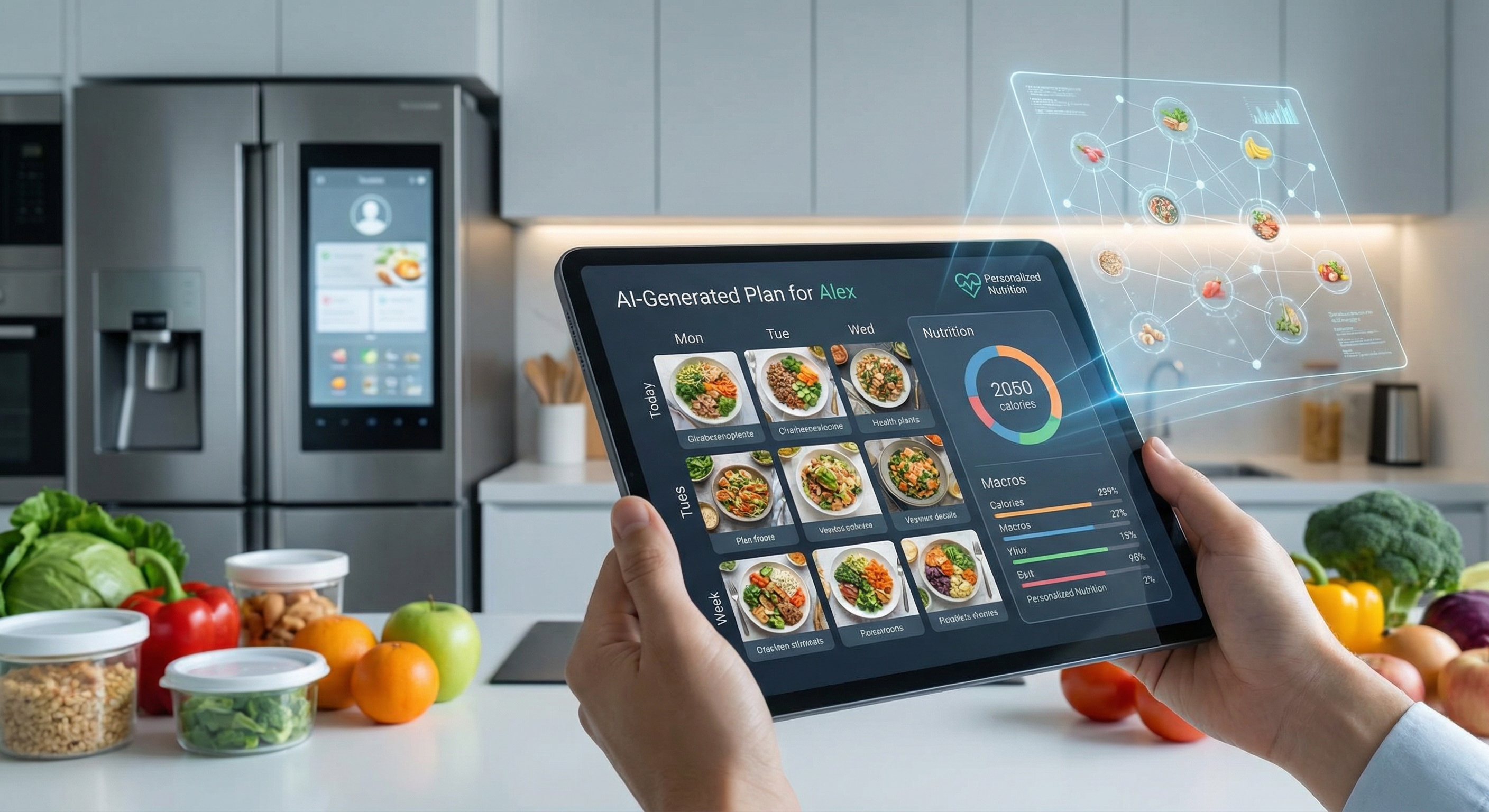
AI meal planning uses artificial intelligence to automatically generate personalized meal plans based on your nutritional targets, dietary preferences, food allergies, budget, cooking skill level, and available time. Instead of spending hours browsing recipes and manually calculating whether a week of meals hits your macro targets, an AI system does the math in seconds and delivers a complete plan tailored specifically to you.
Traditional meal planning — even with the help of a dietitian — is a time-consuming process that requires balancing dozens of constraints simultaneously. A weekly plan needs to meet calorie and macro targets, avoid allergens, respect food preferences, minimize ingredient waste across meals, stay within budget, and offer enough variety to prevent boredom. Humans can do this, but it takes significant expertise and time. AI excels at exactly this kind of multi-constraint optimization.
According to a 2021 study published in Frontiers in Nutrition, AI-generated meal plans met nutritional adequacy criteria 92% of the time when given proper constraint parameters — comparable to plans created by registered dietitians, but generated in a fraction of the time and at a fraction of the cost.
In 2026, AI meal planning has moved from experimental research into mainstream consumer applications. Apps and platforms now generate not just daily meal suggestions but full weekly plans with grocery lists, prep instructions, and automatic nutritional tracking — making personalized nutrition accessible to anyone with a smartphone.
"AI meal planning represents a fundamental shift in how we approach dietary guidance. For the first time, we can deliver truly personalized nutrition at population scale — plans that adapt in real time to individual preferences, biological responses, and lifestyle constraints." — Dr. Christopher Gardner, Professor of Medicine, Stanford Prevention Research Center
How the Technology Works
AI meal planning systems use a combination of optimization algorithms, machine learning, and large language models to generate plans that satisfy multiple constraints simultaneously. Here's what happens under the hood:
1. User Profile and Constraint Gathering
The system collects your data: age, weight, height, activity level, health goals (fat loss, muscle gain, maintenance), dietary restrictions (vegetarian, keto, gluten-free, halal), food allergies, ingredient dislikes, cooking time preferences, and budget parameters. This forms the constraint set that every generated plan must satisfy.
2. Nutritional Optimization
At its core, meal planning is a mathematical optimization problem. The AI selects from a database of thousands of recipes and food combinations, finding the set of meals that comes closest to your macro and micronutrient targets while respecting all your constraints. This is similar to the kind of linear programming used in logistics and supply chain management, but applied to nutrition.
3. Preference Learning
Modern AI meal planners use machine learning to improve over time. When you rate a meal, swap a suggestion, or consistently skip certain ingredients, the system learns your implicit preferences. After a few weeks of feedback, the plans become significantly more aligned with what you actually enjoy eating — not just what's nutritionally optimal on paper.
4. Recipe Generation and Adaptation
Some advanced systems use large language models to create or adapt recipes dynamically. If no existing recipe perfectly fits your constraints, the AI can modify one — substituting ingredients, adjusting portions, or combining elements from multiple recipes to create something new that meets your specific needs.
5. Grocery List and Prep Optimization
Smart meal planners also optimize for practical efficiency. They reuse ingredients across meals to reduce waste and cost, organize grocery lists by store section, and sequence meals to maximize ingredient freshness — using produce that spoils fastest earlier in the week.
Benefits Over Traditional Meal Planning
AI meal planning offers several concrete advantages over doing it yourself or working with a dietitian:
Speed and Convenience
A human spending time meal planning typically needs 1–2 hours per week to plan meals, check nutritional balance, and build a grocery list. An AI generates a complete, nutritionally balanced weekly plan in under 30 seconds. This time savings alone makes healthy eating more accessible for busy people who would otherwise default to convenience food.
Precision at Scale
AI doesn't approximate — it calculates. When your plan targets 2,100 calories with 160g protein, 210g carbs, and 70g fat, the AI selects meals that collectively hit those numbers with high precision across the week. Manual planning typically involves rounding and estimating, leading to accumulated errors.
Continuous Adaptation
Your needs change — you travel, get sick, start a new training program, or simply get bored. AI meal planners can regenerate or adjust plans in real time. Didn't like Monday's dinner? Swap it and the system recalculates the rest of the week to compensate. Traditional static meal plans can't respond this dynamically.
Cost and Accessibility
Working with a registered dietitian for personalized meal plans typically costs $100–300 per session in the United States, putting regular dietary guidance out of reach for many people. AI meal planning tools deliver comparable personalization for free or at a fraction of the cost, democratizing access to nutrition guidance.
Reduced Decision Fatigue
Research in behavioral psychology estimates that the average adult makes over 200 food-related decisions per day. AI meal planning reduces this cognitive load significantly by pre-making the vast majority of those decisions, leaving users with more mental energy for other priorities.
Current Limitations of AI Meal Planning
Despite rapid progress, AI meal planning in 2026 still has notable limitations that users should understand:
Cultural and Regional Food Gaps
Most AI meal planning systems are trained primarily on Western food databases and recipes. If your diet centers on regional cuisines — West African, Filipino, Central Asian, or indigenous foods — the system may have limited recipe options and less accurate nutritional data. This gap is narrowing as databases expand, but it remains a meaningful limitation for many users worldwide.
Context Blindness
AI doesn't know that you had a stressful day and want comfort food, that your in-laws are visiting and you need to cook for six, or that the grocery store was out of salmon. Current systems can adapt to explicit input (you can tell it these things), but they can't read situational context the way a human dietitian would intuit during a conversation.
Over-Reliance Risk
If users follow AI meal plans without understanding the nutritional principles behind them, they don't build food literacy. The plan works as long as you follow it, but without understanding why certain foods are chosen, users struggle to make good decisions when the plan isn't available — at restaurants, social events, or while traveling.
Recipe Quality Variability
AI-generated or AI-adapted recipes can sometimes produce combinations that are nutritionally sound but unappetizing. A meal that perfectly hits your macros but pairs incompatible flavors or textures won't get eaten. Systems are improving through user feedback loops, but the gap between "nutritionally correct" and "genuinely enjoyable" still exists.
Medical Nutrition Needs
AI meal planners are not substitutes for medical nutrition therapy. Individuals with diabetes, kidney disease, eating disorders, or other clinical conditions should work with healthcare professionals. While AI can support these populations, it should complement — not replace — professional guidance for complex medical dietary needs.
The Future of AI Nutrition
AI meal planning in 2026 is impressive, but the technology is still in its early stages relative to where it's heading. Several emerging trends will reshape how AI interacts with our diets over the next few years:
Biomarker-Responsive Planning
Continuous glucose monitors (CGMs), wearable metabolic sensors, and at-home blood testing kits are becoming mainstream consumer products. Future AI meal planners will integrate this real-time biological data to adjust plans on the fly. If your CGM shows that white rice spikes your blood sugar more than sweet potatoes, the AI can automatically adjust carb sources across your plan without you needing to ask.
Gut Microbiome Personalization
A landmark 2015 study published in Cell demonstrated that individuals have highly variable glycemic responses to identical foods, driven in part by gut microbiome composition, and that personalized diets based on microbiome data could successfully predict and regulate blood sugar responses. As microbiome testing becomes cheaper and more accessible, AI meal planners will incorporate this data to generate truly individualized plans based on how your body responds to specific foods.
Multimodal Input Integration
Future systems will combine voice logging ("I just had a handful of almonds"), photo recognition (snap a picture of your fridge and the AI plans meals from available ingredients), wearable data, and purchase history to create a seamless, low-effort planning experience that requires almost no manual input.
Sustainability Optimization
AI meal planners are beginning to factor in environmental impact — suggesting lower-carbon protein sources, reducing food waste through smart ingredient reuse, and optimizing for seasonal, locally available produce. This trend is likely to accelerate as consumers and regulators increasingly prioritize sustainable food systems.
The global AI in food and nutrition market was valued at $4.9 billion in 2023 and is projected to reach $15.8 billion by 2028, reflecting a compound annual growth rate of over 26% — driven largely by consumer demand for personalized, automated dietary guidance.
How NutriMind Uses AI Meal Planning
NutriMind integrates AI meal planning as part of its comprehensive nutrition tracking ecosystem. The app's AI Meal Suggestion feature generates personalized meal recommendations based on your remaining daily macro targets, your logged food preferences, and your dietary restrictions. Instead of staring into the fridge wondering what to eat, you can ask NutriMind's AI Macro Coach "What should I eat for dinner?" and receive a specific suggestion that fits perfectly into your remaining calorie and macro budget for the day.
What sets NutriMind apart is that meal planning and meal tracking live in the same app. When you follow an AI-suggested meal, it's already pre-logged — no additional data entry required. And if you deviate from the suggestion, you simply log what you actually ate using photo recognition, barcode scanning, or manual search, and the AI adjusts future recommendations based on the updated data.
NutriMind's AI also learns from your patterns over time. If you consistently swap out suggested breakfasts for something simpler, the system adapts and starts suggesting quick-prep options in the morning. If you always cook chicken on Sundays, it factors that into your weekly suggestions.
AI meal planning isn't about removing your autonomy over food choices — it's about giving you a smart starting point that saves time and removes guesswork. If you're curious about what AI-powered nutrition planning feels like in practice, try NutriMind free and let the AI handle the planning while you focus on enjoying the food.
Written by Johnny
Founder of NutriMind and health-tech developer. Johnny builds AI-powered tools that make nutrition tracking faster and more accessible for everyone.
Connect on LinkedIn →Try NutriMind Free
AI-powered food tracking, barcode scanning, macro coaching, and more — available on iOS, Android, and web.