Decline Close-Grip Bench To Skull Crusher
A upper arms exercise targeting the triceps, performed with barbell.
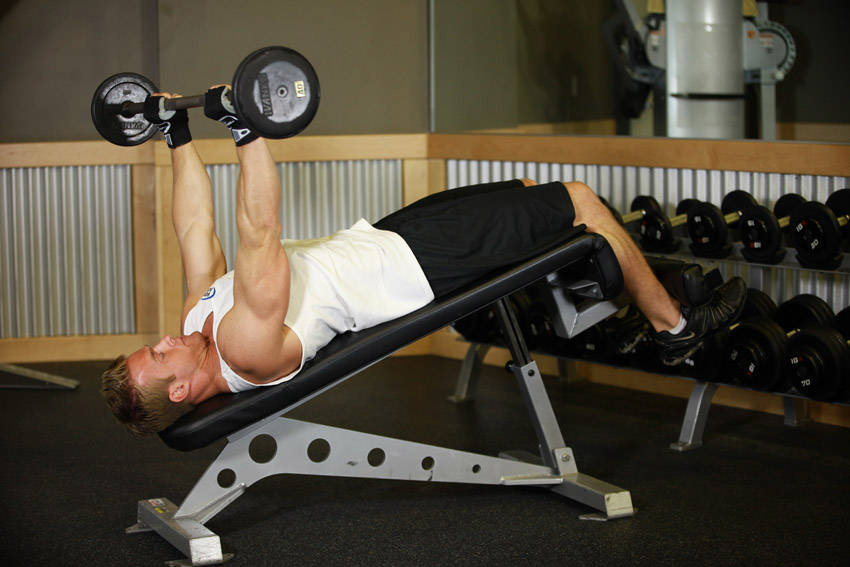
How to do Decline Close-Grip Bench To Skull Crusher
Secure your legs at the end of the decline bench and slowly lay down on the bench.
Using a close grip (a grip that is slightly less than shoulder width), lift the bar from the rack and hold it straight over you with your arms locked and elbows in. The arms should be perpendicular to the floor. This will be your starting position. Tip: In order to protect your rotator cuff, it is best if you have a spotter help you lift the barbell off the rack.
Now lower the bar down to your lower chest as you breathe in. Keep the elbows in as you perform this movement.
Using the triceps to push the bar back up, press it back to the starting position as you exhale.
As you breathe in and you keep the upper arms stationary, bring the bar down slowly by moving your forearms in a semicircular motion towards you until you feel the bar slightly touch your forehead. Breathe in as you perform this portion of the movement.
Lift the bar back to the starting position by contracting the triceps and exhaling.
Repeat steps 3-6 until the recommended amount of repetitions is performed.
Muscles worked
Primary (target)
Secondary
Related exercises
active style cable pushdown
assisted standing triceps extension (with towel)
assisted standing triceps extension (with towel) with horizontal
assisted triceps dip (kneeling)
band close-grip push-up
band side triceps extension
Track Decline Close-Grip Bench To Skull Crusher in NutriMind
Log your sets and the app does the rest — automatic PR detection, progression charts for every lift, and progressive overload that adjusts your next workout. Paired with AI nutrition coaching so your training and your plate pull in the same direction.
Planning your next heavy session? Estimate your max with the One Rep Max Calculator and build up to it with the Warm-up Calculator. More free tools →