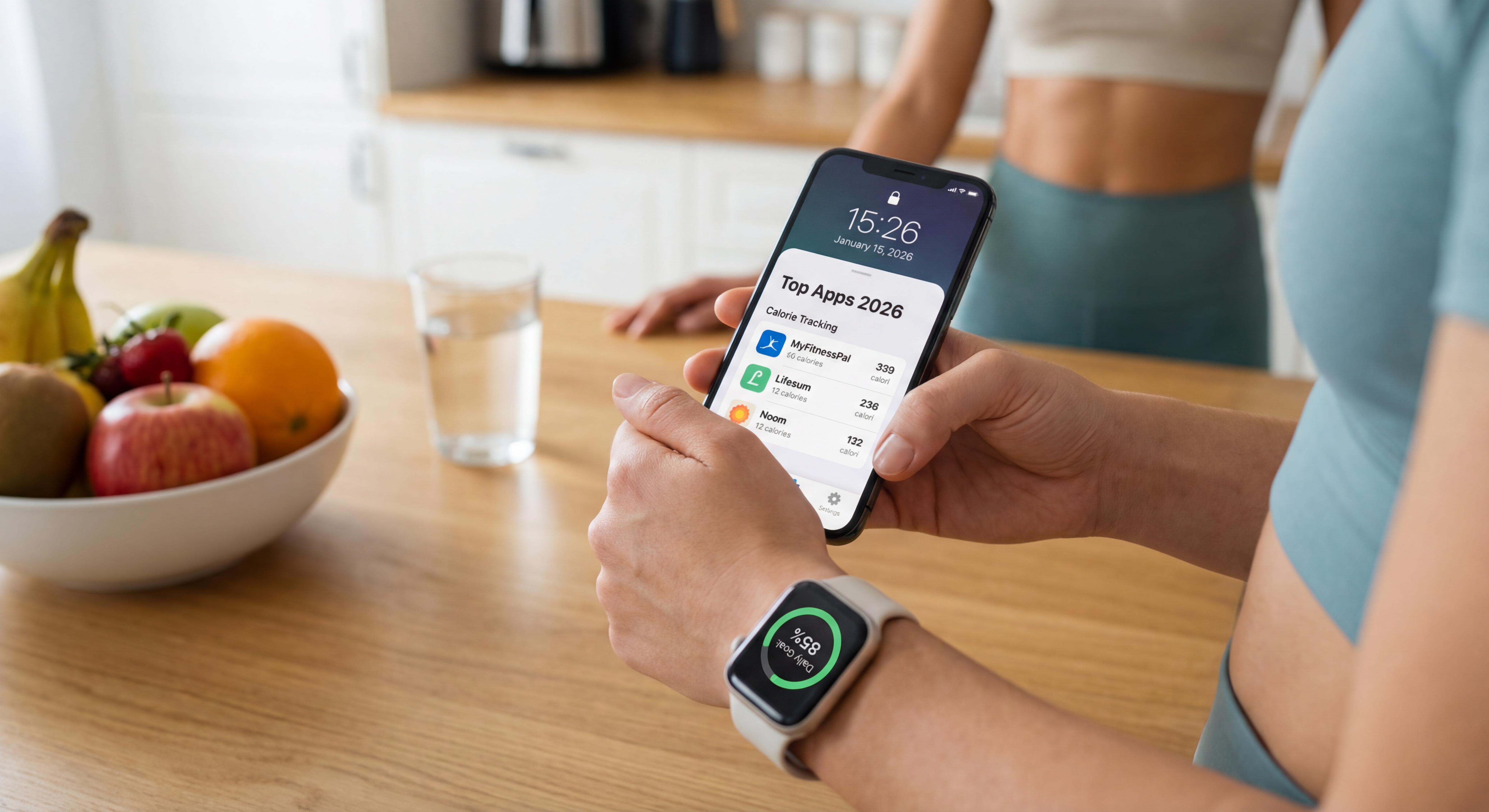
Why AI Is Replacing Manual Calorie Tracking
Manual calorie tracking has always had the same problem: it works, but almost nobody sticks with it. You search a database for "grilled chicken breast," guess the portion size, scroll past 30 similar entries, and repeat for every item on your plate. Do that three to five times a day, and it's no surprise that fewer than 3% of nutrition app users maintain daily logging beyond six months, according to research published in the Journal of Medical Internet Research.
AI changes the equation by shifting the effort from you to the algorithm. Instead of describing what you eat in a database search, you show the AI — through a photo, your voice, a barcode scan, or a simple text description — and it handles identification, portion estimation, and macro calculation in seconds.
A 2019 systematic review in the Journal of Medical Internet Research found that image-assisted dietary assessment reduced participant burden by over 50% compared to traditional methods, while maintaining comparable accuracy for energy and macronutrient estimation.
"Technologies that automate the most tedious parts of food logging — identification and portion estimation — will be key to achieving the long-term adherence needed for meaningful health outcomes." — Journal of Medical Internet Research
The result? People who use AI-powered tracking log more consistently, track for longer periods, and report significantly less frustration with the process. In 2026, AI calorie tracking isn't a gimmick — it's the default approach for anyone serious about sustainable nutrition habits.
Photo-Based Calorie Tracking: Snap and Log
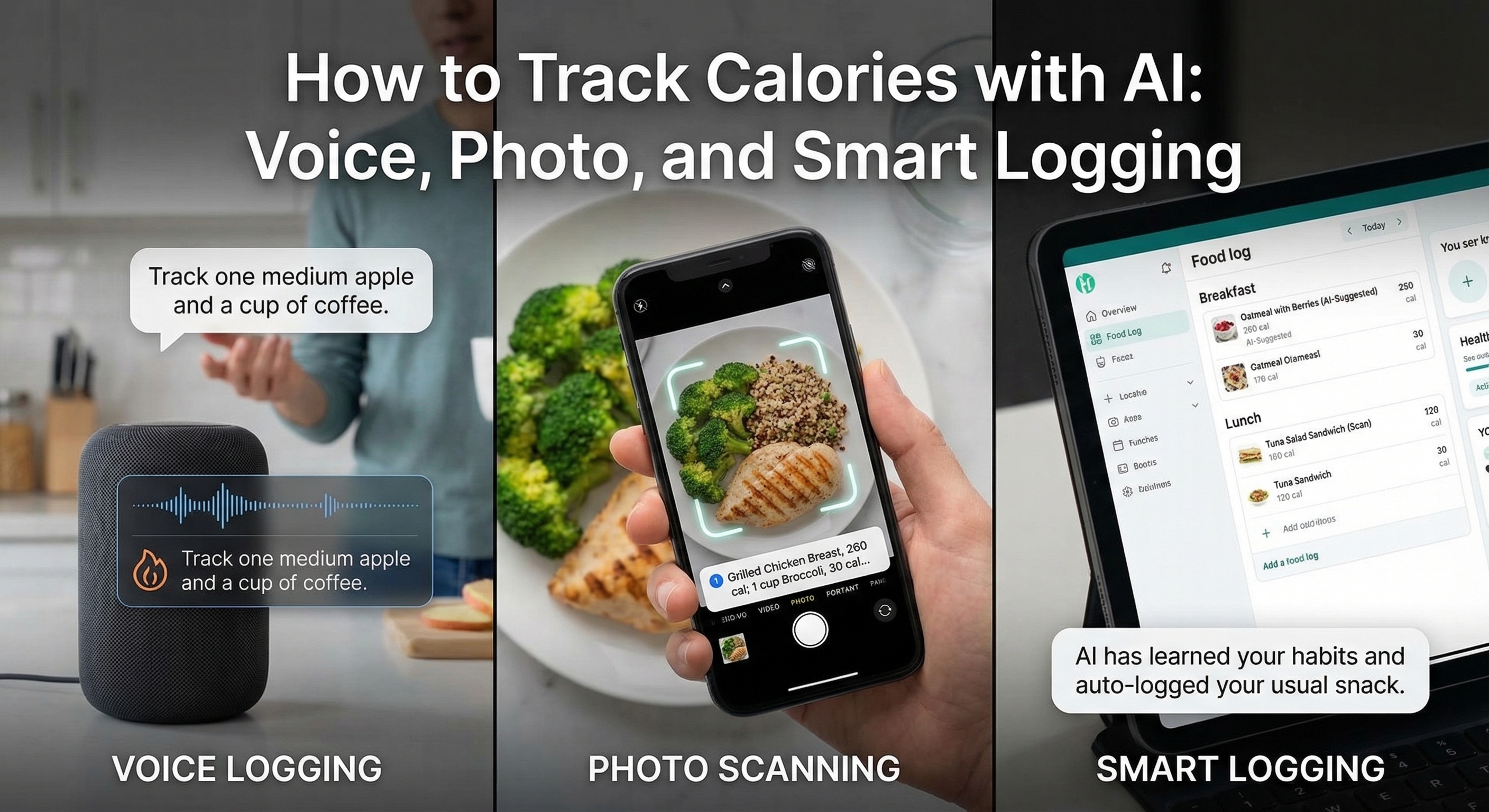
Photo-based tracking is the most popular AI logging method in 2026. You take a picture of your meal, and the AI identifies every visible item, estimates portion sizes, and returns a full calorie and macronutrient breakdown — usually in under 10 seconds.
How It Works
Modern food recognition systems use a multi-stage pipeline:
- Image preprocessing: The photo is normalized for lighting, white balance, and resolution so the model receives consistent input regardless of environment.
- Object detection: The AI segments the image into distinct food regions — separating your rice from your chicken from your vegetables.
- Classification: Each detected region is matched against a taxonomy of thousands of known foods, including visually similar items like white rice vs. cauliflower rice.
- Portion estimation: Using visual cues like plate size, food depth, and spatial relationships, the model estimates how much of each food is present.
- Nutritional lookup: The identified foods and portions are matched to verified nutritional databases to return calories, protein, carbs, fat, and micronutrients.
According to a 2023 systematic review in Nutrients, AI food recognition systems now achieve accuracy rates between 80% and 95% on standard food image datasets — and that number continues to improve as training datasets grow.
Tips for Better Photo Results
- Shoot from a 45-degree angle to give the AI the best view of all items without occlusion.
- Use good lighting — natural daylight works best and reduces color distortion.
- Keep plate edges visible so the model can use them as a size reference for portion estimation.
- Photograph before mixing — snap the salad before adding dressing, the bowl before stirring.
Photo tracking is ideal for home-cooked meals, restaurant plates, and any food you can clearly see. It turns a 3-minute manual logging session into a 5-second photo.
Voice Logging: The Fastest Way to Track Calories
Voice-based food logging is the breakout trend in AI calorie tracking for 2026. Instead of typing or photographing, you simply speak: "I had two scrambled eggs with toast and a glass of orange juice" — and the AI parses your natural language, identifies each food item, estimates portions, and logs the full nutritional breakdown.
This approach is gaining traction because it removes every physical barrier to logging. Your hands can be full. Your phone can be in your pocket. You can log while driving, cooking, or walking out of a restaurant. It's the closest tracking has ever come to zero effort.
How Voice Logging Works
- Speech recognition: Your spoken words are transcribed to text using on-device or cloud-based speech-to-text models that support dozens of languages.
- Natural language understanding: The AI parses the transcript to identify individual food items, quantities, and preparation methods. It understands phrases like "a large bowl of oatmeal with blueberries and a drizzle of honey" and breaks them into distinct nutritional entries.
- Nutritional analysis: Each identified item is matched to nutritional data, with portions inferred from context clues in your description (e.g., "a large bowl" vs. "a small cup").
- Confirmation: You review the results and confirm with a single tap — or adjust if the AI misheard something.
When Voice Logging Shines
- Hands-free situations: Cooking, eating, driving, or multitasking.
- Complex meals: It's faster to describe a homemade stir-fry with six ingredients than to photograph and label each one.
- Quick snacks: Saying "a banana and a handful of almonds" takes 3 seconds.
- Widget-based logging: Some apps now let you tap a microphone button on your home screen widget and log without even opening the app — speak, confirm, done.
A 2018 study published in Obesity found that reducing the friction of food logging directly correlated with improved adherence — participants who logged consistently, even imperfectly, lost 50% more weight over 6 months than inconsistent trackers. Voice logging is the lowest-friction method available today.
Barcode Scanning: Instant Data for Packaged Foods
For anything with a barcode — groceries, protein bars, drinks, frozen meals — barcode scanning delivers the fastest and most accurate results. You point your camera at the barcode, and the app retrieves exact nutritional information from a verified product database in under a second.
Why Barcode Scanning Is Still Essential
- Exact accuracy: No estimation involved. The data comes directly from the manufacturer's nutrition label, so the calories, macros, and ingredients are precise.
- Speed: Scanning takes about one second — faster than any other method.
- Packaged food coverage: Modern databases contain millions of products across global markets, covering most grocery store items.
When to Use Barcode Scanning vs. AI
Use barcode scanning when the food has a package with a visible barcode — it will always be more accurate than photo or voice recognition for packaged items. Use AI methods (photo, voice, text) for restaurant meals, home-cooked food, fresh produce, and anything without a barcode.
The best AI calorie tracking apps in 2026 offer all methods in one place, so you always have the fastest option available regardless of what you're eating.
Text-Based AI Analysis: Type and Track
Text-based AI analysis sits between manual database search and voice logging. Instead of searching for each food item individually, you type a natural-language description of your entire meal — "chicken Caesar salad with croutons and parmesan, side of garlic bread, and a diet Coke" — and the AI breaks it down into individual components with full nutritional data.
Advantages Over Traditional Search
- One input, multiple items: Describe your whole meal in one sentence instead of logging each item separately.
- Context-aware portions: The AI infers reasonable portion sizes based on how you describe the meal. "A big plate of pasta" yields different estimates than "a small side of pasta."
- Handles recipes: You can describe a homemade dish by listing ingredients, and the AI will calculate the combined nutritional profile.
Text input is particularly useful when you're logging a meal from memory or when the food isn't in front of you to photograph. It's also a good option in quiet environments where voice logging isn't practical.
How to Get the Most Accurate Results from AI Tracking
AI calorie tracking is fast and convenient, but a few habits will improve your accuracy significantly:
- Be specific with voice and text descriptions. "Grilled salmon fillet, about 6 ounces, with a cup of brown rice and steamed broccoli" gives the AI much better data than "fish and rice." Include preparation methods, approximate quantities, and any added fats or sauces.
- Log cooking oils and sauces separately. A tablespoon of olive oil adds 120 calories and 14g of fat. AI can estimate these if you mention them, but they're easy to forget. Make it a habit to include them.
- Use barcode scanning for packaged items. When you have the option, a barcode scan is always more precise than photo or voice recognition for packaged foods. Save AI methods for meals without barcodes.
- Review and adjust when you know more. If you measured your rice with a cup before plating, update the portion. AI estimates are a strong starting point, not a final answer.
- Log immediately. Whether you use photo, voice, or text, log the meal right after eating. Waiting until the end of the day introduces recall bias — you're more likely to forget condiments, beverages, and sides.
Research in the American Journal of Clinical Nutrition consistently shows that tracking consistency matters more than tracking precision. Logging every meal at 85% accuracy produces better outcomes than logging two meals perfectly and skipping the rest.
"The best tracking method is the one you'll actually use every day. AI reduces the effort enough to make daily logging sustainable for the average person — and consistency is what drives results." — Dr. Eric Helms, Sports Nutrition Researcher, Auckland University of Technology
AI Calorie Tracking with NutriMind
NutriMind brings every AI logging method together in a single app — photo recognition, voice logging, barcode scanning, text analysis, and traditional database search — so you always have the fastest option available.
- Photo logging: Snap a picture of your plate and get a full calorie and macro breakdown in seconds. Works for home-cooked meals, restaurant dishes, and snacks.
- Voice logging: Tap the microphone and describe what you ate in natural language. NutriMind's AI parses your description, identifies each item, and logs the nutritional data — no typing required. You can even voice-log directly from the home screen widget without opening the app.
- Barcode scanning: Point your camera at any packaged product for instant, exact nutritional data from a database of millions of items.
- AI text analysis: Type a description of your meal and let the AI do the rest — ideal for logging from memory or in quiet environments.
- AI Macro Coach: Not sure if you're on track? Ask NutriMind's AI coach questions like "Am I eating enough protein?" or "What should I eat for dinner to hit my macros?" and get personalized guidance based on your daily logs and targets.
Every method feeds into the same daily tracker, giving you a clear visual breakdown of your calories, protein, carbs, and fat against your personalized targets. The app calculates your goals during onboarding using your age, weight, activity level, and objectives — whether that's fat loss, muscle gain, or maintenance.
If you've tried calorie tracking before and quit because it was too tedious, AI-powered tracking removes that barrier. Try NutriMind free and see how effortless calorie tracking can be when AI does the heavy lifting.
Written by Johnny
Founder of NutriMind and health-tech developer. Johnny builds AI-powered tools that make nutrition tracking faster and more accessible for everyone.
Connect on LinkedIn →Try NutriMind Free
AI-powered food tracking, barcode scanning, macro coaching, and more — available on iOS, Android, and web.